
This Column Has Seven Days #023 // How I Learned To Stop Worrying And Love Jack Kirby

This week I have to take a little time to talk about the King of Comics, Jack Kirby. Yesterday (Aug. 28) marked what would have been the man’s 97th birthday, and it’s hard to be a comics fan and not at least know a little about what he did. The man started working on comics in the 1930s and was still making comics in the 1980s. To call his output prolific is an understatement. So what is the best way for an interested yet cautious reader to begin exploring the man’s voluminous body of work? I’m not sure I can answer that to everyone’s satisfaction, but I can tell you what worked for me.
Devil Dinosaur and OMAC: Introduction to Kirby 101
When I started digging into the history of comics, I had a shameful secret: I didn’t like Jack Kirby. I read some of his early Marvel comics work and thought his writing was too bombastic and simple, and that his art was loud and ugly. After a few years, I tried Kirby again, this time his 1970s Captain America run, and I still couldn’t appreciate it. It was only when I read two of his arguably more obscure works — Devil Dinosaur from Marvel and OMAC from DC — that I began to appreciate the brilliance of Kirby’s style. Neither series ran more than 10 issues, and they couldn’t exactly be described as highbrow or thought-provoking. But it was only through their sheer power and audacity that I realized just how great Jack Kirby was.
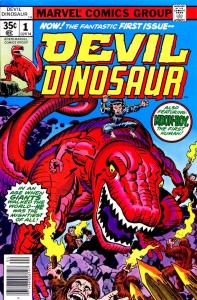
Cover of Devil Dinosaur #1 - April 1978
The first of the two that I read was Devil Dinosaur, originally published by Marvel in 1978. Kirby was assisted on these issues by Mike Royer, who inked and lettered the series. It’s the story of Moon Boy, the First Human, and his pet, the red-skinned Tyrannosaurus rex called Devil. In nine issues, Devil and Moon Boy battle other dinosaurs, murderous cavemen, giant insects, and a giant who wears a Triceratops skull as a helmet. And then things get really weird. Later in the series there are alien monsters, a computer system from another planet, and a witch who sends Devil forward in time to the Nevada of 1978. It’s loud and silly, and reading it in my early 20s, it blew my mind.
What I had previously interpreted as over-the-top in some of Kirby’s other work was a perfect fit for the dinosaur-fighting action on practically every page of Devil Dinosaur. It’s a cave-boy riding a Tyrannosaurus, after all — there’s no room for subtlety. I was hooked from the very first two-page splash in issue #1, where Devil squares off against a Triceratops, surrounded by a half-dozen other dinosaurs while a volcano erupts in the background. Each beast in the scene was captured at the height of its movement and extension, and even now when I re-read it I feel energy vibrating off the page. Kirby’s fantastic sense of design is also on fine display in this series; the monster on the two-page splash in issue #4 is one of the most beautiful and terrifying the man ever created. Devil Dinosaur is the kind of comic I would have given my left arm to read as a five- or six-year-old, and I would give it to a child today without hesitation. (Well, a copy that isn’t my Marvel Omnibus. That’s not a cheap book; I don’t want peanut butter and jam smears on it.)
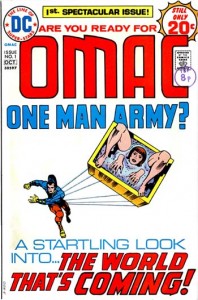
Cover of OMAC #1 - October 1974
The series that sealed the deal for me as far as Jack Kirby goes, though, is 1974’s OMAC, published by DC Comics, with D. Bruce Berry and Mike Royer taking on the inking and lettering chores. OMAC takes all the dynamism and high-concept explosiveness that Kirby had used in Devil Dinosaur and unleashes them completely. In “the world that’s coming,” corporate drone Buddy Blank is transformed into the super-powered One-Man Army Corps, an agent of the Global Peace Agency. He is assigned missions that are too dangerous to use a large force to deal with, which is great because OMAC is strong enough to lay out a dozen soldiers with one punch and fast enough to dodge an entire ballistic missile array while seated in a flying chair. He also has assistance from Brother Eye, an orbiting satellite that is OMAC’s best friend.
OMAC reads like Jack Kirby read a synopsis of George Orwell’s Nineteen Eighty-Four and said, “It’s got potential, but what if that Winston Smith was a super-soldier who could suplex a building?” The near-future setting allows Kirby room to give some of his most outrageous ideas free reign; in this series OMAC takes down a plant that creates synthetic people, smashes his way through a city that was rented out for a supercriminal’s party, and foils the plans of Doctor Skuba, who was trying to steal all the water in the world. The fight scenes are even more powerful and exciting than those in Devil Dinosaur; any time OMAC moves or poses he looks as though he is at the absolute apex of his power.
Jack Kirby has done other books that are more widely appreciated, but to me the eight issues of OMAC are his masterpiece. There are more ideas in a single issue of OMAC than in 20 or 30 issues of today’s average corporate comic book, and each page of OMAC has at least one panel that has been “homaged” by an artist in the 40 years since it first came out.
I still don’t love everything Jack Kirby did; for example, I find his early Fantastic Four issues merely okay, something that I fear may cause me to be burned in effigy. But even in those works that I find underwhelming, I am never disappointed in his passion and creativity. It was these two series, cancelled before their time, that lit that Kirby spark inside me, and I hope they can be for someone else as well.
* * * * *
This week I did a little bit more than re-examine the legacy of the most important figure in the history of American comics, though. Here’s what else piqued my interest since the last time I wrote.
Comics: If you like comics and/or conspiracy thrillers you probably should give Andy Diggle and Jock’s Snapshot a try. It’s the tale of Jake Dobson, a comic shop employee who discovers a cellphone abandoned in a park on his way to work, and picks it up in the hope of grabbing some extra cash. When he takes a look at the phone, however, he discovers that there’s only one contact number, and also that it’s full of photos of dead people. The four-issue series is pleasantly reminiscent of Diggle & Jock’s work on The Losers but on a smaller scale; it unfolds quickly, with twists you don’t see coming, secret organizations, and adrenaline-pumping action. Jock’s art is very striking in black and white, and he’s always effective with big action moments as well as the perfect body language for any given moment. I found it a quick but exciting read, and would definitely recommend seeking it out.
Film: A few weeks ago TCM broadcast a few of Robert Benchley’s short black-and-white films, and I just got around to watching them. I like Benchley a lot; he started as a columnist and writer for the Harvard Lampoon, Vanity Fair and The New Yorker in the 1910s and 1920s, then transitioned to acting, starring in films like You’ll Never Get Rich and The Major and the Minor. Benchley’s satirical short subjects take a certain sense of humour to get behind, but I was a fan of one of his greatest influences, Stephen Leacock, at age eight, so I definitely fit the bill. Some of his films are available on YouTube, and if you’re interested in that sort of thing, I would recommend How To Start The Day, How To Vote, and How To Be A Detective. Go watch them and then marvel at how my physical shell can house the soul of a 100-year-old man.
* * * * *
That’s about it for me this week. Until next time, go read some Kirby comics. Whether you’re a longtime fan or just starting out, I really think you’ll find it worthwhile. I’ll see you in seven days.


 Devin R. Bruce says:
I absolutely agree that Transmetropolitan is an incredibly smart book that...
Devin R. Bruce says:
I absolutely agree that Transmetropolitan is an incredibly smart book that...
 best of the week: july 24 | Live Within Your Space says:
[…] have some paper piles staring me down. In fun times...
best of the week: july 24 | Live Within Your Space says:
[…] have some paper piles staring me down. In fun times...
 Norman Dale says:
This is an excellent deflationary analysis clearing up some of the...
Norman Dale says:
This is an excellent deflationary analysis clearing up some of the...
 Scotto says:
Man, thanks for sharing. I relate pretty hard right now, I...
Scotto says:
Man, thanks for sharing. I relate pretty hard right now, I...
 Brandon Schatz says:
Yeah, I love the Grizzly. I think he ends up being...
Brandon Schatz says:
Yeah, I love the Grizzly. I think he ends up being...