
People Are Wrong: Zero Dark Thirty

Welcome to yet another column where James admonishes people for things! It’s like The Culture Hole, except more exasperated, if that’s possible.
I think that at this point it should surprise exactly nobody that I have opinions and I like talking about them. That’s literally up there on my list of favourite things, alongside bees, baseball, barbecue and talking about all three of them, preferably in the same conversation. And, like any person with a healthy-to-problematic ego, I believe that most people who disagree with me – specifically when they don’t like something – are wrong. Sometimes, this can be fun – take most of my conversations with my friend Brittney or the occasional screaming match about whether Roger Moore is the worst Bond (he is) – but sometimes, the sheer weight of people being wrong can be draining.
And brother, there are a lot of people who are wrong about Zero Dark Thirty.
I get the various reactions to it; it’s a movie about a touchy subject, and one that intersects with politics at that, which is a whole other wasp nest. It eschews certain elements of a traditional plot structure and I can see how in some of those ways it failed to connect with people. But those things aside, there are two frequent complaints about the movie that are literally objectively wrong and I am here to tell you what they are and why they are horseshit.
One thing right off the top: “It’s not accurate!” doesn’t even rate as a complaint. Because, really, the movie was so accurate in a lot of ways that it actually got accused of basically stealing classified intel. The screenwriter, Mark Boal, is a former embedded journalist with experience in the conflict, and the filmmakers literally spent hours scouring footage and photographs of Osama Bin Laden’s Abbottabad compound to recreate it exactly as it was to further the verisimilitude of the barely fictionalized Operation Neptune Spear, and I say “barely” because I am 60% sure that Chris Pratt wasn’t actually there that night on May 2nd, 2011.
So really, what the “It’s not accurate!” complaints boil down to is, “It’s not one hundred percent accurate,” and if you actually expect that in a movie, I’m sorry, you’re stupid. I’m not gonna mince words with that one. Even complaints like those of Nadeem F. Paracha, that the use of Arabic by some characters in Pakistan is inaccurate, can basically be shrugged off as a result of the film not being filmed in Pakistan because, well, Pakistan is still trying to save face over that whole “Osama Bin Laden was here for a while” thing. Listen, if you make a movie that isn’t actual, infallible news footage itself (and even then you get into questions of what wasn’t being shot, etc), there’s gonna be some fiction. Accept that and grow up or get back to insisting that not owning a television makes you special.
Now that I’ve established where the line is about what I consider just a regular wrong complaint and what I consider to be fundamental idiocy beneath my contempt, let’s get back to people being wrong. The two big complaints – at least the two objectively wrong ones – I hear are these:
1. It’s pro-torture (or Pro-America);
B. The central character, Maya, lacks an emotional or narrative arc.
PRO- BOWL
The first one is almost so laughable as to be excluded like the complaints about accuracy. Because really, the producers have said it’s not pro-torture. The director has said it’s not pro-torture. The screenwriter has said it’s not pro-torture. The star has said it’s not pro-torture. At this point, insisting that Zero Dark Thirty is in favour of torture, or that it suggests that torture directly led to the successful killing of Osama Bin Laden, is such a wildly off-base insistence that it’s all just a ploy to trick you into supporting terrorism that the narcissism and self-importance of it all is mind boggling even to me, a person who is literally writing an article about why other people are wrong this very second. There are two main reasons this is wrong; one of them is just a matter of simple viewing comprehension and the latter is a broader problem in the way people often view negative acts in fiction.
As far as viewing comprehension goes, it’s simple. Torture doesn’t lead to the location of Osama Bin Laden. It doesn’t even lead to the name of “Abu Ahmed,” the target of Maya’s pursuit that does eventually lead her to Abbottabad. In fact, at almost every step of the game, torture is shown to be an unreliable method that leads to flawed information or none at all. One detainee insists Abu Ahmed is dead. Abu Faraj gets tortured and still basically lies about knowing Ahmed. Even the torture of Ammar, the man who eventually gives up the name of Abu Ahmed, doesn’t result in the name. You know what does? Basic trickery. Tradecraft. When torture doesn’t work, they lie to him and do it convincingly enough that he believes them.
Afterward, the simple fact of the name being torture-adjacent is enough to make Maya’s superiors doubt her. The giant chunk of the movie is about Maya’s superiors doubting her intel, and if you somehow missed that, I just don’t know what to do with you.
The second reason the idea Zero Dark Thirty is pro-torture is wrong stems from a basic fallacy of viewing: that the presence of torture, relatively unvarnished, without a direct challenge (ignoring those challenges), is inherently pro-torture. And hey, there most certainly is torture in the movie, because torture played a significant role in the search for Bin Laden, if not the actual results. Omitting it would be so grossly, incalculably irresponsible as to ruin the entire movie. You think Zero Dark Thirty was jingoistic as it is? Imagine an alternate cut where nothing but electronic surveillance, ground work, sleuthing and good-cop trickery results in Operation Neptune Spear, where Maya doesn’t start off as being physically ill at the sight of torture to someone who’s entirely comfortable with doing it. That would be your propaganda right there, Naomi Wolf.
Instead, Zero Dark Thirty does something far braver and far more intelligent: it presents a character, an organization, a country, who tortures, gets away with it and wins the day anyway. It asks you to care about them. It dares you to like them. Even though director Kathryn Bigelow might personally say, “Do I wish [torture] was not part of that history? Yes. But it was,” the movie itself plays its politics much closer to the vest. Maya isn’t entirely unlikeable. She’s got a picture of family on her computer desktop that she presumably looks at when she boots up her computer after returning from a black site. She cares about her friends and coworkers. And she tortures, because it’s her job. She doesn’t’ wear a black hat or a white one. She’s a person doing a job and sometimes that job is vile, but she’s still a person in a movie about just that.
So despite all the objects, all the lack of damning evidence, how does Zero Dark Thirty get so regularly branded as a pro-torture movie? It’s that fallacy, again, where a lack of explicit criticism of a negative act is treated by the viewer as an automatic endorsement of it. The eye of the lens, instead of being treated as something closer to an impartial tool, is instead inferred to carry the personal morality of the director all the time. Without a monologue after a scene of torture where Dan turns to Maya and says, “You know, torture is awful and we shouldn’t do it,” people see a protagonist doing something bad and assume that means it’s good from the show’s point of view. It might be familiar to you from when somebody watches Mad Men and says it’s sexist because Don Draper doesn’t treat women that great. It’s bad viewing when that person does it, and it’s bad viewing when someone does it with Zero Dark Thirty.
It’s not just lazy. It’s not just dumb because they should know better than to assume all these other smart people are being duped or are secretly sexist or fans of waterboarding or whatever. It’s bad because it belies something far more insidious: a broken, lacking way of reading into art. It shows a lack of imagination, a refusal to view art with the idea that points of view, however technically-minded, can be nuanced and that lack of overt moral judgment can be an empowering thing for a work. There’s a lot of work to do it, and do it well, and there are people who just don’t get it. And man, that just makes me kinda sad.
POST-ETC
The second objectively wrong argument is that there’s no emotional arc for Maya, Jessica Chastain‘s main character. It’s also the most recent one I came across, when last Friday a local artist I know that is basically my nemesis because he is so wrong so constantly but whatever and I were discussing the Oscars Best Picture nominees and he uttered that gem. I responded so strongly, so immediately to this assertion because at the end of Zero Dark Thirty, I felt like I had just gone on a journey along with Maya, and I at least was certainly emotional by the time the credits rolled. To me, there was absolutely an emotional arc for Maya, and I believe I called Gregg objectively wrong before a minute had passed.
However, I also wanted to understand why Gregg had such a different reaction to the material than I did, which is to say how any person could actually believe something that I find to be so completely and irrevocably wrong. I go through this own personal odyssey about as often as you might think, which is to say almost daily. But still! I genuinely wanted to try to understand this other viewpoint, and I spent the afternoon trying to figure it out.
Good news: I reached a conclusion!
Bad news: This “no arc” idea is still objectively wrong.
Is that it? Of course not. Because, from a certain mindset, I absolutely understand Gregg’s reaction now, and I think it comes from the fact that Zero Dark Thirty doesn’t follow a traditional narrative or emotional structure. And that structure? Leave it to my poor, rushed drawing:
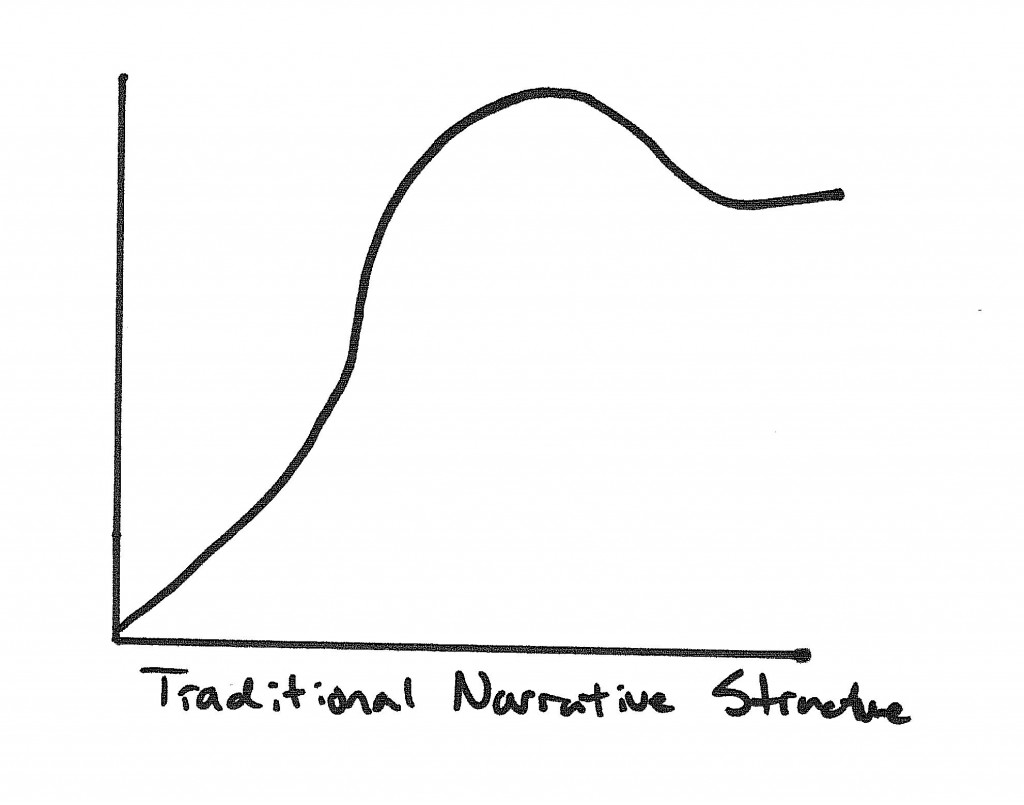
Most movies that aren’t black and white art films follow this structure. The movie starts. A conflict is introduced and it builds to a peak, at which point the smoke clears. This kind of movie is largely defined by two things: the rising action (the upward trajectory) and the climax (the point at which the trajectory switches directions). It comprises about 90% of any given movie.
More importantly, the emotional arc of the movie usually follows the same arc. The protagonist starts off in a relatively stable state, which changes as the story goes on, and reaches a peak around the same time as the climax. There’s a great romance or a personal redemption or something that’s really nice and mostly linear. By the end, their emotional state is resolved.
Zero Dark Thirty doesn’t abide by this structure. Its plot - introduce Maya, look for Bin Laden, Operation Neptune Spear - generally does, but Maya’s personal and emotional arc doesn’t. It looks different:
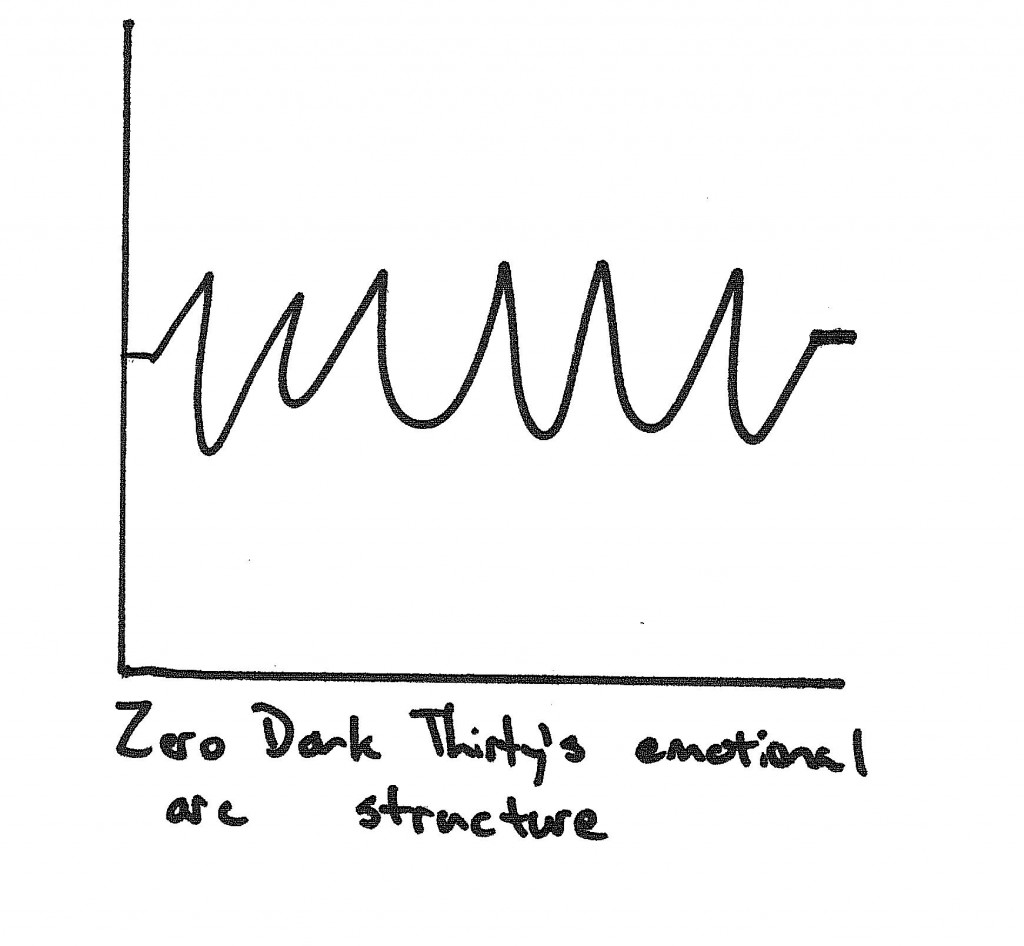
At the end of the movie, Maya is basically in the same place she was at the beginning. She’s still a CIA operative. She hasn’t been promoted and she hasn’t fought back against some sort of discrimination. She hasn’t loved and lost and loved again. She’s the motherfucker that found this place. Despite the setbacks, explosions and the coworkers that have come and gone, she’s endured. She’s stuck with it. She’s stayed in place, at great emotional cost.
And that’s what Zero Dark Thirty is about, really. It’s about the struggle to keep an even keel in an uneven environment. She struggles a bit with the torture aspect of her work, but grows accustomed to it. Somebody questions her evidence, so she finds more. Somebody blows up her coworker, but she gets new ones.
Think about that: having to respond to all of those curves, for ten years, all in the service of the mission? That’s tough. It would have broken me. It nearly broke Maya at a few points in the movie. She did it, though. That’s what all those rises and falls in the arc above are: they’re Maya’s struggle to keep going. Each one represents an IED or a doubting superior or something that was in her way, but the arc is this: she outlasted them all. She outworked them all, even though it wasn’t easy.
That’s what that final shot means. It’s not a trite “oh heavens now it’s over and I can show a single emotion,” as I was somewhat flippantly told. It’s Maya acknowledging, just for one second, how much she’s been through, what she’s had to do, and how long it’s taken. We know from her computer desktop background that she’s got a family. The fact that we only know this from her computer screen makes that final scene all the more impactful. She had to put a lot on hold to do her job. Now, she can show it.
Maybe. The movie subverts the standard expectations by not even resolving that much. Maybe she gets promoted afterward, maybe she gets a medal. Or maybe she doesn’t. Sometimes the job has to be its own reward and its own journey. Sometimes, you’ll have to cry and then get off the plane, write a report and get back to work. That’s what Zero Dark Thirty is saying: it took a lot to get to that plane, and that has to be enough on some level. It certainly was for me, and it certainly wasn’t for Gregg.
It’s one thing not to like this kind of narrative arc, or, to put it more accurately, series of smaller, shorter arcs. But to say that what Maya did isn’t a journey because it wasn’t a traditional Hollywood isn’t just wrong; like the aforementioned assumptions about the eye of the camera, it is, simply put, a misreading of art. It would be dishonest to the experience of people like Maya to force a Jerry Bruckheimer arc on them; they play the slow, steady game, filled with tiny disappointments and victories and a million disasters that aren’t a climax because that would imply there isn’t going to be another one in three months. The point of Zero Dark Thirty is that these things are messy, and that staying with them regardless might make you look static, but feels like anything but that. Being stoic isn’t easy and pretending otherwise is ultimately fruitless at best and disingenuous at worst.
The realism of Zero Dark Thirty means that it’s got a much looser approach to plot structure - a much more postmodern one - than other movies. That can alienate viewers, like Gregg. It can polarize opinions and that’s even if it’s done well. Not liking stuff is always okay, no matter what I say the next time someone insults Batman 1966. But at least try not to be objectively, incontrovertibly wrong about it.


[...] Leask went to town on critics of the film Zero Dark Thirty. It’s well worth the read — I love James’ [...]
Brilliant.
I wish I could say more but you’ve already said it.
This is an excellent deflationary analysis clearing up some of the more obvious mis-allegations against Zero Dark Thirty. But what I find mots puzzling and almost unworthy of rebuttal is the weak complaint that the movie fails to follow a conventional emotional narrative arc. My first response if the claim was true would be, “so what?” There are so many postmodern movies now that eschew that arc and the idea that in the end there redemption awaits, that if ZDT departed that mould it would join almost innumerable others. Try sketching out the “development” in “Blue Velvet”, “Once Upon a Time in America”, “A Clockwork Orange”…obviously I could go on but in this case there is no need because ZDT was highly conventional. In teh early stages Maya is caught up in teh web of uncertainties and false starts typical of any classical protagonist. Some progress is made with the bloody but very temporary setback of having her best buddy blown to bits in the suicide bombing by Al-Balawi. But not long after, after Maya’s entertaining though predictable struggles against bureaucrats and political who don’t believe in her analysis, the main almost sole purpose she has is accomplished: Bin-Laden is eliminated and in the final scene, Maya is getting a special military transport ride home, to the amazement and admiration of the flight crew. I simply can’t think of how this narrative and its conclusion could be any more conventional.