
Best of the Week // Goodbye, Farewell, Auf Wiedersehen and Snikt

Welcome, dear readers, to another week of comics and commentary at Comics! The Blog! We kick things off, as always, by handing out awards for the Best of the week – beginning with two Award postings (well… usually), followed closely by the past week’s Best.
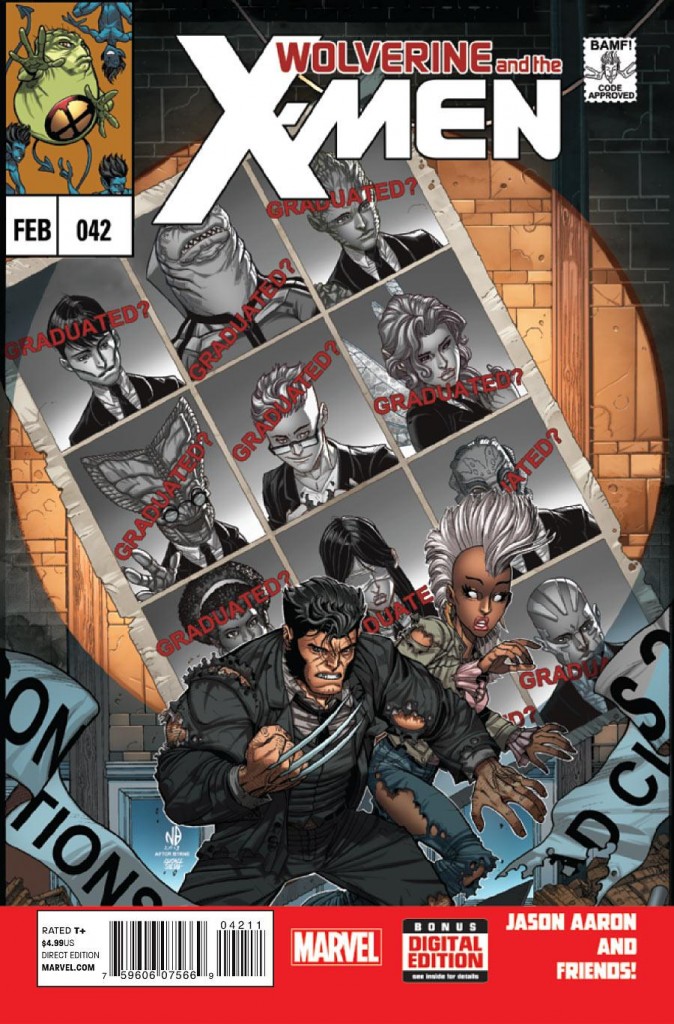
It’s weird to feel nostalgic about a series that’s only a couple of years old. After all, Wolverine and the X-Men isn’t really a classic run (…yet). But while it’s too early to look at it in terms of impact, the reality is that 42 issues is a long time for a creator to work on a comic, and the end of a series, especially a relatively long-running one, is an important and useful time to look back at the series, how it progressed and what it means to you now. Luckily, Jason Aaron is a very canny operator and has, along with his artists, made Issue #42 a literal and figurative trip down memory lane.
I say literally because half of the issue is a future version of Wolverine looking back at his school after its final day and the other half is Quentin Quire looking back at the firebrand he used to be and wondering where it all went wrong, now that he’s a popular class president who almost never tries to tear down the system. But where that kind of familiar story becomes rewarding is where the book expands on it, casting a wider net to look at the often glorious, often convoluted past of the X-Men. In superhero comics, the greatest skill a writer or artist can often have is the ability to recycle or remix the past, and that’s where the “looking back at the good old days” aspect of Wolverine and the X-Men #42 comes into play. All these great, classic X-Men elements are there - villains turning into heroes, heroes turning into villains, the Phoenix, the school, the student becoming the teacher, the secondary mutations, the Brotherhood, even the future versions of characters recapping a version of the near future that may or may not happen - but they’re served with not only a wink, but the warm remembrance of friendship. Even the artists on the book itself is a run down memory lane of some of the series’ best and most iconic, like Nick Bradshaw, Ramon Perez, Steven Sanders and ending the way it started, with Chris Bachalo. But they’re drawing new stuff, with the added tease of the new stuff being presented as matter-of-fact old stuff, and old favourites doing new stuff, preferably where a dangerous school is involved, is the reason I still love the X-Men just like I did when I was 10. The issue is a reminder of why these characters still hold so much appeal.
And then there’s Quentin Quire and Wolverine, at its core. At this point, we know Wolverine’s deal: a loner who constantly finds himself surrounded by people and his not-so-secret, secret soft side. We’ve seen it before, we’ve seen it again and the only thing that matters is execution. And let me tell you, Future Wolverine making a quasi-dick joke about how his claws take a few minutes to come out counts as great execution in this book, especially when Ramon Perez is drawing it. Quentin is something else; we’ve certainly seen the young mutant villain becoming the hero before, because that is basically half of all X-Men stories. But we haven’t seen it with Quentin, and not necessarily in this permutation before. His dreaded realization that he’s accidentally become a hero is funny and self-aware, but it also taps into that great element of the X-Men: growing up. This isn’t an adult switching sides because something something Chuck Austen. This is a young man on the threshold of adulthood looking back and asking if growing up is worth it, afraid of his own future. That’s something universal, and it’s also something surprisingly rare in a franchise about teenagers attending school. Quentin surprised himself, and he surprised me. His last line in the series is, “What the hell do I do now?” and even though we’ve seen one possible future, we don’t know what’s next. But over the last few years, we got to see someone get to the point where he can ask that, and have it be earned. That’s the great thing about Jason Aaron‘s work with all his wonderful artists, in this issue and before: they turned something old into something new, that magical alchemy of the perpetual second act.


 Make this weekend an audio podcast listening weekend… | Boozy Boob Tube says:
[…] Episode 11: Doctor Who Christmas Special, Special Double Podcast Extravaganza! with...
Make this weekend an audio podcast listening weekend… | Boozy Boob Tube says:
[…] Episode 11: Doctor Who Christmas Special, Special Double Podcast Extravaganza! with...
 Laury Plant says:
Loving this!
As I told James once, I'm an Angels fan...
Laury Plant says:
Loving this!
As I told James once, I'm an Angels fan...
 Danica says:
Brandon eats lobster at Christmas my family is AWESOME, James. You...
Danica says:
Brandon eats lobster at Christmas my family is AWESOME, James. You...
 Scotto says:
Fact: "Baby When You're Gone" is literally the only thing Brian...
Scotto says:
Fact: "Baby When You're Gone" is literally the only thing Brian...