
This Column Has Seven Days #008 // Putting The Devil Back In The Bottle

This past weekend, the Easter Bunny delivered me a long weekend filled with a return of my damn head cold. I’m not normally against sequels on principle, but that was one I would rather not have had to sit through. However, that gave me a lot of time on the couch to watch movies and, when I could focus for an extended period of time, read. I generally enjoyed myself too, aside from one movie. (Oh Police Academy: what the hell were we, as a culture, thinking?) So come along with me while I give you a brief summary of the best of the week and try not to cough too much.
Daredevil by Mark Waid, Volume One
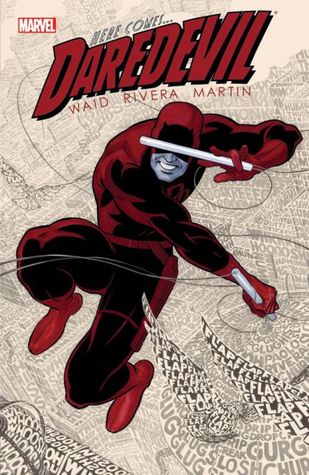
art by Paolo Rivera
(Note: this section spoils a few “recent” Daredevil storylines. If, like me, you think that “recent” is “any time in the last five or six years.”)
This book is a couple years old now, and has been sitting on my shelf for nearly that long. Like many readers, I have grown up with the post-Frank Miller Daredevil, and though I always knew that there was once a time when Daredevil was little more than Spider-Man with fewer quips, my favourite Daredevil stories have always been those where Matt Murdock just keeps getting kicked while he’s down and still manages to come out in (mostly) one piece.
When Mark Waid was brought on to the book to make it fun again, I was intrigued but was entirely unconvinced that he could put the genie back in the bottle. After all, Matt had lost three or four loves of his life, had his secret identity revealed, seen his best friend killed, spent time in jail, and been possessed by a demon. How do you do fun comics with him after all that?
Turns out, it takes just a handful of brilliant creative types and a commitment to the idea. The six issues in Daredevil by Mark Waid, Volume One don’t ignore the character’s past, but rather put a new spin on things, and allow Matt Murdock to enjoy life for once. Before reading it, I thought that Mark Waid might have wrapped things up too neatly for me to swallow, but every plot point was thoughtfully addressed and then either solved, postponed, or inverted. Each time it happened, I nodded sagely to myself, said “Huh, that makes sense” under my breath, and smiled. Waid was dealt a stacked deck and still came out with a great hand.
It doesn’t hurt to have a set of amazing artists backing him up, either. The first three issues were penciled by Paolo Rivera and inked by Joe Rivera, with art by Javier Rodriguez; the second three were illustrated by Marcos Martín and coloured by Muntsa Vicente and Javier Rodriguez. The art styles for each arc are very distinct, but both feel like part of the same overall story. Waid and the Riveras put together a neo-classic comic with all the things that made early Daredevil interesting: soap opera, acrobatics, and swashbuckling flair. Every character, from Matt and Foggy themselves to bit players who don’t even take up an entire page, have a distinct look, body language, and facial expressions, and that is a great accomplishment that some very well-regarded modern artists have a hard time pulling off.
As good as that story was, though, Martin knocks it out of the park. Not only does he do everything I loved in the early stories, he also composes ingenious panel layouts that break down movement into small chunks or giant splash panels as the situation demands it. The sound effects by Chris Eliopolous sound effects that are used more effectively than any mainstream comic I’ve ever read (and that includes Incredible Hercules). Martin has captured my imagination entirely. I must read more of his work. I must.
One final thing about the artists that I really liked was the way each art team represents Daredevil’s radar sense. Each version is unique to their story but still similar enough to be cousins, artistically speaking. Which, if you think about it, is a very clever way to visually represent something that is entirely non-visual — the visual medium can’t fully capture it, but each artist can show you their version. Which is also a great summary of this first Daredevil volume: two sides of the same story. The art and the writing each support and elevate the other, and it’s really a treat to behold.
I know I’m late to the party, but this book is phenomenal. Read it. Love it. Live it. And then read it again.
* * * * *
As good as the upbeat adventures of Matt Murdock have been, however, it hasn’t been all shiny, happy men without fear over in this neck of the woods. Here’s what else I’ve been up to this past week.
Comics – I randomly pulled Fantastic Four: Books of Doom off the shelf for a re-read to see if I was going to keep it or if it could go in one of my monthly purges. I liked the story quite a bit considering it was basically Doom: Year One, but there was one aspect of the book that rubbed me the wrong way. Mark Farmer’s inks are nice and thick on top of Pablo Raimondi’s pencils, but they end up softening the faces of most of the characters, which makes for a lot of almost doughy people. The rest of the art — Doom’s armour, the castles, the robots —is actually fairly compelling, it’s just the face work. But Ed Brubaker manages to tie a lot of Victor von Doom’s past together to make a satisfying origin; my favourite parts of the story were where modern-day Victor, who is narrating the story, tries to explain his youthful behaviour, and ends up contradicting what the art is showing you. Doom has to re-create his personal history to fit his current narrative, and Brubaker makes it believable without being unsubtle. Verdict: it’s staying on the shelf for a little while longer. It needs a third read, at least.
Comics – Here’s a modestly shameful comic reading secret: until this week, I don’t think I’d read anything by Charles Burns. After reading X’ed Out, though, I will definitely be reading more Charles Burns. X’ed Out was full of many different things I like in a story: mind-altering drugs and bizarre characters and suspense and monsters and punk rock and misunderstood youth, and as it all started slowly weaving itself together I started to feel genuine dread. Parts of it felt like Horror Tintin, parts of it felt like Love & Rockets, but the visual style, mostly the smooth, strong inks, tied it all together. Burns is very effective in shifting between the different story threads, and he often moves away from one aspect of the story just as I wanted more, which only added to the suspense without frustrating me. The only time I was disappointed in X’ed Out was when I got to the end and realized it was continued in another volume. I will find it though. I need to see where this story goes.
Television – After being told by more than a few people to watch the British sitcom Black Books, I finally got a hold of the first season at the library. I watched the pilot last night and I am happy to say that it’s smart and sarcastically funny. The show features Dylan Moran as the misanthropic and high-strung Bernard Black, owner and operator of the bookstore Black Books. The show also stars Tamsin Greig as Bernard’s best (only?) friend and owner of the knicknack shop next door, and Bill Bailey as an accountant who hates his job and by the end of the pilot becomes Bernard’s assistant. Watching this show, almost 15 years old at this point, I found it interesting what you would have been able to do on British TV at the time, compared to a typical American sitcom. Not necessarily the topics of humour, but rather how the topics were addressed. I loved watching Bernard poking fun of the upperclass twits trying to keep up appearances, talking to door-to-door missionaries who don’t know the first thing about the product they’re selling, and antagonizing skinhead football fans. He does the frazzled misanthrope very well, and carried the pilot on pure charisma and delivery. I thought Greig’s character was a little underwritten in the pilot, but she’s such a good performer that she still managed to make a very strong impression. My favourite scenes, though, were those with Bailey, who got to do it all in the pilot: frantic mania, serenity, confusion, and a dose of physical comedy. I look forward to the rest of the first series, and would recommend it to anyone who has ever worked in a bookstore (or similar retail), or who enjoys acidic humour.
Movies – As a fan of the James Bonding podcast, I have given myself a quest to watch (or re-watch) every James Bond film. This week I revisited a movie that I was surprised held up better than I thought it would: The World is Not Enough. Denise Richards is truly awful, but if you can get past the fact that she … exists, this is actually a much better Bond than I had given it credit for. The antagonists are actually interesting and compelling (one is practically a supervillain), the plot is decent for a Bond film, it has at least one thrilling chase scene, and Pierce Brosnan looks like he’s actually having fun for most of it (which he is decidedly NOT in Die Another Day). It treads awfully close to Roger Moore territory, but Denise Richards aside, I actually found myself really enjoying it. Denise Richards, though. I’d like to find out who thought that was a good idea.
* * * * *
Well, that’s all for this week. Until next time, watch some James Bond, exercise your inner supervillain, and try to plug up a hole in your reading history. I’ll see you in seven days.


I remember watching Black Books on CBC way back when. Never saw it all, and I’ve always meant to pick up the dvds or find some other way of seeing it. It was SO GOOD. I need it in my life again.
Well, we may be able to do something about that…