
This Column Has Seven Days #004 // Just You & Your Idol, Singing Falsetto

I really feel like I’ve been slacking the past seven days. I know I got up to some kind of business or other, but when I look back on it I only have a couple of pop culture things I really keep coming back to. So I guess this column might have a bit more focus this week. Let’s start at the beginning and see where that takes us!
Young Avengers in 2006 and 2013
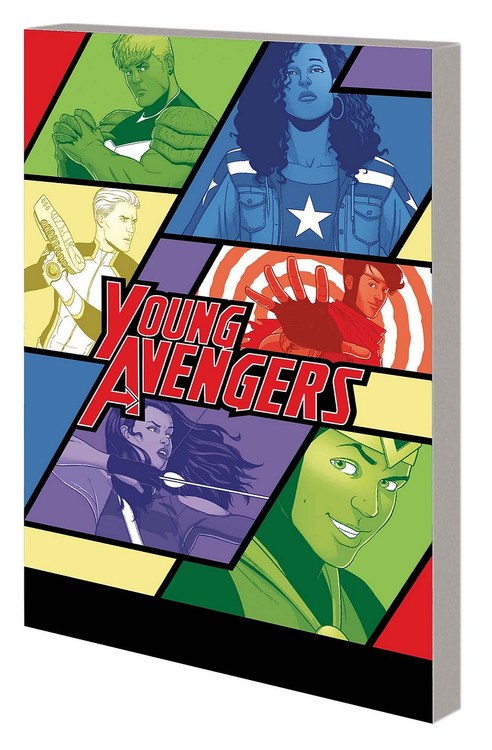
I spent a lot of time this weekend catching up on my Regina pile of unread new comics, and though I enjoyed quite a few of them (Velvet, Black Science, The Bounce and, of all things, Moon Knight), the ones that stuck with me the most were the last two issues of the most recent Young Avengers series by Kieron Gillen, Jamie McKelvie, and a host of others. Issues 14 and 15 were the resolution of their Young Avengers story, which I liked quite a bit, actually, and feel like I’ll probably like it even better upon re-reading the whole thing. However, when I’d finished reading those two issues, what I really felt like doing was going back and reading the 2006 Young Avengers series, by Allan Heinberg and Jim Cheung (with Andrea DiVito on issues 7 & 8). I remember flipping through it rather quickly when it first came out, enjoying the art but not really absorbing much of the story, so I was looking forward to the re-read.
Now it’s true that I’m not really in the target age demographic for either of the Young Avengers series, but I can appreciate good stories for good stories. The two volumes feel very different, but they’re both very good, for different reasons.
Heinberg and Cheung’s 2006 Young Avengers series starts off feeling like a fairly traditional superhero book. For one thing, it opens with the grown-ups, and doesn’t feature the title characters (other than on the front page of a newspaper) for 12 pages. As a reader, you’re getting introduced to them, easing into the established Marvel Universe, so that kind of storytelling technique makes sense. When you finally see Hulkling, Patriot, Asgardian, and Iron Lad (and then later, Kate Bishop and Stature) in action, they’re brash and excitable and even rather fannish when it comes to dealing with the adult Avengers that they come across. It starts off being fairly predictable, though both well-written and beautifully illustrated (Jim Cheung made his name on this book, and it’s easy to see why).
But something interesting happens during these 13 original issues. As you get to know these kids, they really start feeling like their own characters. They’re not copies of the Avengers like one might immediately assume. They have their own thoughts, feelings and goals, and they really seem like the kinds of thoughts, feelings, and goals that 14- and 15-year-olds would have.
As the story continues, it hits all the great superhero beats. The twist at the end of the first issue is akin to the twist at the end of the first issue of Thunderbolts, though not quite as universe-shattering, and Heinberg and Cheung bring in a lot of heroes and villains as supporting characters to these kids, which gives the series an interesting perspective on the familiar universe. The stories are set very much in 2006 continuity without being beholden to it, which is refreshing. You don’t really need to know much about what was happening at that time in publishing history to enjoy the stories, which makes this volume of Young Avengers a fairly evergreen book.
To me, though, it felt a little weird going back to the first Young Avengers run after reading McKelvie and Gillen’s series, because the McKelvie and Gillen take on the characters felt so familiar. It might be partially due to the fact that I’m so used to their work together on Phonogram. It’s definitely not the same kind of storytelling, not by a long shot, but the feel is familiar. The characters, too, are so well-defined as people on the cusp of their 20s, that going back to them in their early teens feels jarring.
Like I said before, Heinberg and Cheung’s series feels like a traditional superhero book that also manages to encompass the Young Adult angle. Gillen & McKelvie’s Young Avengers eschews those big beats. Sure, there are supervillain fights that are astounding, but it also has a lot of relationship talk and philosophical discussions about tight-harmony girl groups and also pancakes. And those fight scenes I mentioned earlier are so creatively rendered they make me energized and excited just thinking about them. This Young Avengers feels unlike anything that a mid-2000s comics fan would understand, showing that the medium in general has moved forward tonally, thematically, and structurally, and that a corporate superhero book can reflect and build on those changes.
The biggest change in the two books for me, though, is the kinds of stories they’re telling. The first volume of Young Avengers is a teenage book: practically every story is about wanting to do your own thing but adults telling you that you can’t. Gillen & McKelvie’s Young Avengers is a book for young adults, ones who are both thrilled by and a little afraid of their own agency, having to leave the trappings of childhood behind, and it ends with walking into the future where they’re slowly realizing they might not be the “new generation” any more.
At the end of issue 15, Gillen said he thought that it would be nice to think of Young Avengers as a “prestige series,” a thought he quickly dismissed as egotistical. But I think the Young Avengers work best as characters in a boutique book. I think it’ll be nice to step away from them for a while, and then check back in with them. These characters work well when they don’t have a ton of continuity bogging them down, and I think the tendency as a writer would be to grow them too quickly. A 10-15 issue miniseries every few years would be a good way to keep them fresh.
Because how do you grow these characters in this universe if they have a 30- or 40-issue ongoing series? With Peter Parker being nebulously between 23 and 29 (I am guessing, giving a little leeway here and there); if he can’t be older than 30, then how long will it take before Kate Bishop becomes potential dating material for him? It’s not an actual question, because first of all, established Marvel continuity has glitches all over the place, and second of all, Kate Bishop would eat Peter Parker for breakfast. But that imaginative exercise does go to show that it’s hard to make the Young Avengers fit outside of the pocket universe that they’ve existed in the past year or so. That’s why I think is why the 2013 Young Avengers series worked so well: you just focus on these characters (and other young characters of the Marvel Universe). The less they interact with the other characters, the less cognitive dissonance.
(Before I close this down, I have to say: I absolutely adore the fact that Gillen so blatantly wrote in the fact that the big party that closes down this Young Avengers run is serving fruit juice and only fruit juice. Because of course they wouldn’t be drinking. They’re only 17-year-old sexy young superheroes at a party, for god’s sake. The fact that the characthers mention it so blatantly at the end completely nullifies the fact that it was even mentioned.)
So at the end of the day, though both Young Avengers series are very different in both the stories they tell and how they tell them, they’re also both very good comics. If you’ve only read one and not the other, I’d remedy that as soon as possible.
* * * * *
It hasn’t been all adolescent superheroes and fruit juice over here this week, though. Here’s what else has been on my mind this week.
Music: It’s not new, but I listened to The Dears’ Degeneration Street about four times while I was reading both of the Young Avengers series. Not sure if they would have made it on to Kieron Gillen’s playlists, but they’re a bleak and operatic band that I have loved for years now, and the tracks from that album really did set a good mood for reading much of the most recent series.
Podcasts: I listen to a lot of podcasts, and I’m not trying to take your attention away from the very deserving podcasts featuring the people who contribute to this website. However, if you have a couple hours in the week that you think could be improved by laughter, I would strongly recommend The Andy Daly Podcast Pilot Project. Andy Daly is a very funny, very dark comedian, who has produced a set of podcasts featuring some of his weirdest, most popular characters. Each episode is a “pilot” hosted by one of his characters — theatrical director Don DiMello, waterskiing legend Hot Dog, cowboy poet and foe of the supernatural Dalton Wilcox and more. Each podcast features guests played by other comedians, including Paul F. Tompkins, Matt Besser, Maria Bamford, and the podcast’s co-producer Matt Gourley. These are not light and fluffy: Andy Daly’s sense of humour is incredibly black, and any given episode can get strange at almost any moment. For example: the travel podcast features H.R. Gieger, the former pope Benedict XVI, and Werner Herzog as co-hosts. But if stuff like that appeals to you, then you really should give them a shot. Many of the episodes are extremely re-listenable, so much so that I’m now even further behind in my podcast listening than normal. Such is the power of Andy Daly.
* * * * *
And that’s all for this week, folks. Until next time, try tackling something from your “to-read” stack, re-watch True Detective for a third time (I can’t stop watching), and maybe take it easy for a couple days. You deserve it. I’ll catch you in seven days.


 ryan k says:
I have a copy in terrific condition in anyone is interested...
ryan k says:
I have a copy in terrific condition in anyone is interested...
 iv says:
I like licensed comics but you might say all I read...
iv says:
I like licensed comics but you might say all I read...
 Laury Plant says:
Joe Mangianello. Well played. Exceptionally well played.
And I still await your...
Laury Plant says:
Joe Mangianello. Well played. Exceptionally well played.
And I still await your...
 Scotto says:
Here you go B., you didn't hallucinate it: http://www.rollingstone.com/music/pictures/gallery-the-best-break-out-bands-on-rolling-stones-cover-20110502/britney-spears-1999-0973071
Scotto says:
Here you go B., you didn't hallucinate it: http://www.rollingstone.com/music/pictures/gallery-the-best-break-out-bands-on-rolling-stones-cover-20110502/britney-spears-1999-0973071
 Scotch & Comics Episode 021: Let’s All Have Some Cake | Scotch & Comics says:
[…] a link to my column on Comics! The Blog. It’s...
Scotch & Comics Episode 021: Let’s All Have Some Cake | Scotch & Comics says:
[…] a link to my column on Comics! The Blog. It’s...