
Best of the Week // As Great as we Hoped it Would Be

Welcome, dear readers, to another week of comics and commentary at Comics! The Blog! We kick things off, as always, by handing out awards for the Best of the week – beginning with two Award postings, followed closely by the past week’s Best.
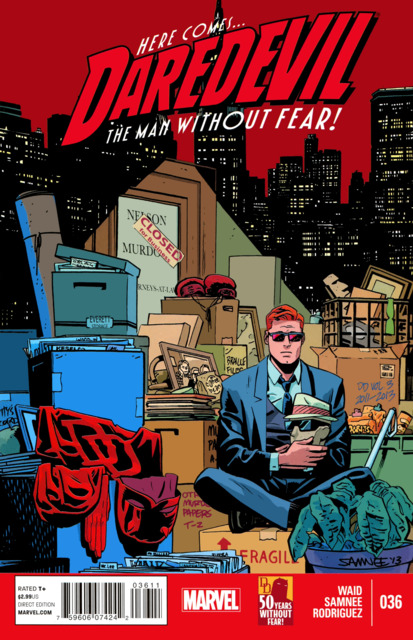
I firmly believe Mark Waid‘s run on Daredevil - two and a half years and 36 issues, give or take a Point One - will go down as one of the best in superhero comics history. I’ve said it for a while now, and despite all the chances for something to go wrong, for a subplot to fizzle or an art mistake to derail a story, none of that happened. Thirty-six issues and the worst of them was still “very good.” As a collective achievement for Waid and his creative partners like Chris Samnee and Javier Rodriguez, it’s a staggering accomplishment, being that good, that consistently.
Of course, Daredevil #36 wasn’t the best comic of the week just because it was a good comic at the end of a great run. It was a great cap to the run because it was a great issue in and of itself. It’s Matt Murdock saving the day, in a big bold way that resolves the cliffhanger of revealing his secret identity to defeat a racist criminal organization, and it includes bone-crunching violence in the defense of the American way. It’s got an emotional, come-to-Jesus conversation between Matt and his best friend. Another life-changing decision is made. It ends on a kiss. It’s basically the exact kind of thing I want from my superhero comics, for the 36th time. It’s a masterclass in structure, the elegance of Samnee‘s line expression and how Rodriguez imbues that final scene with the soft glow of a singular setting sun. It’s wonderful. All of it. Shocker.
But what’s truly amazing about it, besides the nuts and bolts of the craft - it’s not really news, after all, that Mark Waid and Chris Samnee are good at comics - is how succinct it all is. This isn’t the end of Daredevil or of Daredevil; he’ll be back next month in print and even sooner on ComiXology. But it’s the end of this era of it, and to make that satisfying, the book’s team had to do two things: make Matt’s move to San Francisco something logical, and do it while making a statement about Daredevil as a man. The book succeeds marvellously at both. It’s almost silly how matter-of-factly the move to San Francisco comes about. Matt torches his entire legal career in New York in the act of defusing the Sons of the Serpent, and he needs a fresh start not just for himself, but to care for Foggy during his illness. And since he’s been disbarred by New York, it’s almost impossible to practice law anywhere else… unless he’s done it before. Cue the Bay Area, and that often-forgotten part of Matt’s history. It’s a really fun way of bringing of the character’s part without being overtly beholden to continuity. What Waid shows is that continuity needs to fit into the stories you want to tell, not the other way around. And when artisans are making the story, neither half has to be sacrificed.
All this feeds into the second criterion of success, the celebration of Matt as a character. As a lawyer who’s also a superhero, one thing that this series has held up during its run is that Matt is a man of utmost character. He does the right thing and he doesn’t compromise, because heroes don’t do that, at least not morally, not where it counts. He couldn’t let the Serpents win, but he couldn’t betray his own morals to beat them either. Matt did something bold - something unquestionably right, coming to terms with a part of himself he’s resisted examining too closely thus far - and he accepted the consequences. In triumphing over the Serpents, he triumphed over his own worst secret impulses. He was brave, and he did it all - fighting racism, saving lives and caring for his friend - without knowing what was going to happen first. He jumped without looking, because it was the right thing to do.
That’s Daredevil.


 Danica says:
James James James,
You thought Max was cool. You cannot convince...
Danica says:
James James James,
You thought Max was cool. You cannot convince...
 Scotto says:
Fact: "Baby When You're Gone" is literally the only thing Brian...
Scotto says:
Fact: "Baby When You're Gone" is literally the only thing Brian...
 James Leask says:
Oh, it's not an issue with your end! You sounded completely...
James Leask says:
Oh, it's not an issue with your end! You sounded completely...
 Kelly Thompson (@79SemiFinalist) says:
Sorry I'm so echo-y! You should have told me I could...
Kelly Thompson (@79SemiFinalist) says:
Sorry I'm so echo-y! You should have told me I could...