
Regarding Justice League 3000
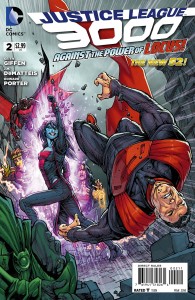
art by Howard Porter
01. This one is going to be filed under “credit where credit is due”. It’s also going to be done as a numbered list because it’s very, very late and why not hang a hat on my shortcomings? It’s the Comics! The Blog way!
02. I was completely ready to hate this series. It takes quite a bit of work to get me to judge a series before it’s even released, but through the use of a very single-minded type of willpower, DC did it.
They started by announcing a reunion of creators whose work I had quite enjoyed, Keith Giffen, J. M. DeMatteis and Kevin Maguire creating a new kind of Justice League book from the ground up, set in the future where surely no mandate could touch them. I began to salivate over what such a team could accomplish with the opportunity they had been given. Their previous work together completely flew in the face of the current DC house style, and would probably create a bit of a strange buzz. My hope was for the book to be wonderful, funny and weird (while still maintaining that sense of importance the team always managed to instil within even the silliest of moments) and shake the DC universe (and its architects) from the doldrums of the grim-fisted super heroics the New 52 had been known for. Shortly after I drew up plans to write an article explaining just how important it would be for a book like this to succeed within the DC line-up, the news came down. The higher ups hadn’t liked what the creative team had put together for a first issue. They decided they wanted to go in a different direction - a darker direction. This necessitated the removal of Kevin Maguire from the series, and the instillation of Howard Porter as the new artist. Known for a decidedly darker look, and paired with the supposed edict from up high, I assumed the worst. Given a different set of writers, I probably would have gotten something terrible. What I got was a new DC series that I genuinely enjoy.
03. You don’t need to know much in order to start this series. In fact, the less you probably know, the better. Everything about this book revolves around reveals and discovery as the characters reveal hidden layers to the story while you read. In an effort to create a functioning Justice League in the far flung future, a bunch of strange sciencey types thought it would be a good idea to take some basic DNA and other ephemera, and recreate some of the world’s greatest superheroes. What they didn’t bargain on was the fact that they wouldn’t be complete without the formative events that made then grow up into the super-people they eventually became. What results is a fairly fun series with a team of jerks who have good reason to be acting like petty children. They are newly minted, and largely untested. They’re figuring things out as they go, and are ill equipped for the emotional stakes involved. It’s about a group of flawed people who are acknowledged as imperfect beings, in direct opposition to the current iteration of the Justice League, which features supposed mature and perfected characters acting like jerks because… story reasons? I promised myself I wouldn’t get mired in our usual resigned anger at the current DC line, so I’ll save some of those general thoughts for a piece where I can talk about them with an eye for construction, rather than an unflattering comparison. The point is this: there is a reason for everything that happens in this book, good and bad. When things get decidedly limb-rendy, it doesn’t feel as gratuitous as it has in other comics. It serves a point, and offers a harsh look at just what kind of stakes the puppets and the puppeteers are really deadline with. Much like the story surrounding the book’s change from a lighter read to this version, it’s a darkening with purpose. Oddly enough, in making this book function more in line with the rest of their universe, DC probably did it a huge favour. Their current audience has responded to the book, and they’ve responded well (if sales within my own shop are any indication). They’ve also managed to put a book together in this vein that I can see myself reading month in and month out because… well, because it’s genuinely good.
04. As long as I’m owning up to things, I should probably mention something else. I’ve been quite disheartened over the years as to how regressive DC has been regarding certain properties. The best example of this would have to be the Legion of Superheroes line, which seemed to make a point of going backwards on their own meta timeline, hiring writers who had already written the series instead of hiring a fresh voice to take a crack at a team that’s generally been about optimism and moving forward. When DC was pushing the old JLI team for this series, I will admit that I was quite happy… but in in hindsight, that probably wasn’t a good idea. Yes, there’s a good chance I would have enjoyed that version of Justice League 3000, but it would have been very regressive. Comics in general spend too much time looking backwards when they should be building new things for the future. Forgot what was, think about what could be! Old magic might be reliable, and it might guarantee a certain amount of sales, but it certainly won’t build a nice future, just a fond past and maybe a passable present.
This series, as it is now, is as it should be. It might be using some old ingredients, but it’s trying to tell a new story, and that should be respected, no matter how begrudgingly. Here’s hoping it does well enough to facilitate more of the new, and less of the old.


 James Leask says:
I could lie and say I didn't make a point of...
James Leask says:
I could lie and say I didn't make a point of...
 Scotto says:
There were times before his Spider-Man work when I wasn't hot...
Scotto says:
There were times before his Spider-Man work when I wasn't hot...
 » Image is everything… The Daily Rios says:
[…] comicstheblog.com/2014/01/10/white-people-and-the-image-expo by Brandon Schatz (Jan.10th) […]
» Image is everything… The Daily Rios says:
[…] comicstheblog.com/2014/01/10/white-people-and-the-image-expo by Brandon Schatz (Jan.10th) […]