
Best of the Week // The Superior Tipping Point
Welcome, dear readers, to another week of comics and commentary at Comics! The Blog! We kick things off, as always, by handing out awards for the Best of the Week – beginning with twoAward postings, followed closely by the past week’s Best.

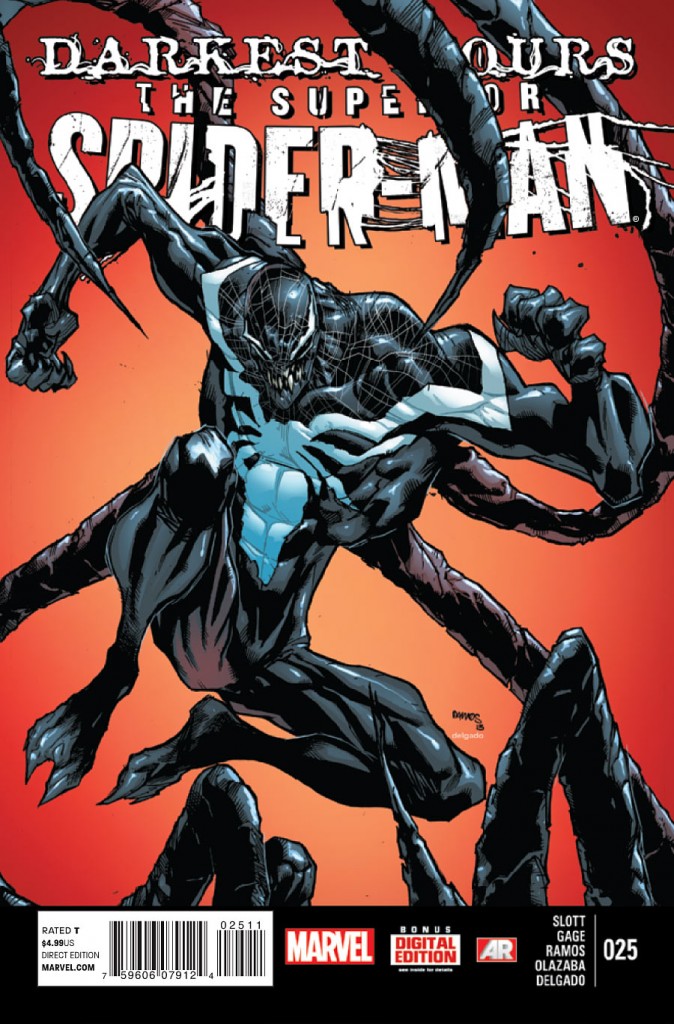
Here at C!TB, we’ve made no bones about how we’ve totally been on the side of having faith in Dan Slott and his collaborators to guide us through his Spider-Plans. And over the last few years, as plot points have been seeded, brought back up, put to rest and winked at, one of the most consistent impressions has been that Slott knows what he’s doing, and he’s setting the book up to hit the beats he wants when he wants it. After all, he set up this whole Otto Octavius as Spider-Man thing back a hundred issues before he actually did it. But it can’t always be seeding, and every once in a while, an arc hits the tipping point and the road to the climax starts in earnest. For Superior Spider-Man, that point was last week’s Issue #25.
Or, I should say, the points. Because one of the hallmarks of the Slott era in the Spider-Office has been his very classic use of multiple, interweaving plots to build to a convalescing point, and this is where a few massive things happen:
- Carly Cooper gets turned into a member of the Goblin King’s court and proves herself to him, a giant character turn that completes the Goblins’ ranks before the King’s final push;
- Otto “explains” himself to Mary Jane as being influenced by the goblin symbiote, convincing her that he’s really Peter and, more importantly, convincing himself that he’s in the clear;
- Meanwhile, Tony Stark convinces the Avengers to go after Otto, not believing he’s really Spider-Man in a callback to their tests on him;
- Most importantly, Peter’s consciousness, long thought gone, makes its reappearance to stop Otto from crossing an important line and set up the return of Amazing Spider-Man.
What I love about all this is that these are big things that happen, but they don’t really resolve any big questions. We still don’t know who the Goblin King is, despite his claims otherwise. We don’t know if Carly’s change is permanent. We don’t know what’s going to happen with Otto and the Avengers, and we especially don’t know how Peter’s going to come back. Just about the only thing we do know is that Otto’s house of cards is about to be knocked down, after a long period waiting for that to happen.
Big questions, with the biggest of all being how they all fit together. That’s exactly where a book like this should be at this stage in its life. If, for a long time, the series’ fundamental question was, “What if Otto really IS a better Spider-Man?”, this issue sets up the next one: “How does the world finally prove him wrong?” It’s a great setup that relies on everything that came before it.
And while it’s tempting to give Slott the bulk of the credit, as his name is the only consistent one on the book, it’s hard to be bad when you’ve got collaborators of this calibre. Christos Gage has been a welcome voice on the book, working with Slott every now and then to help manage the workload and keep things moving at their roaring pace. Without him, I’m not sure the book (and its predecessor) could have hit these milestones. And Gage has an underrated skill in writers: he’s a true collaborator, able to bring his voice to the book but work with someone else’s playground and voice. It’s hard to tell where he and Slott meet; they’re both serving the voice of the book.
Humberto Ramos is possibly my favourite Spider-artist in recent memory. The book is defined so much by its speed and energy, and his slightly exaggerated models and fluid body language naturally fit a book with an acrobatic hero. He’s also able to make Venom (specifically, Otto’s Superior Venom) look grotesque and monstrous; he and Victor Olazaba accomplish an interesting sleight of hand: they give refined line work the impression of being messy and chaotic, mirroring not just the Venom symbiote’s aesthetic, but showing the transition from Otto thinking he’s in control of it to realizing that he’s anything but. As those scenes progress, Ramos and Olazaba shape the lines differently to give the same character a very different emotional feel. It’s great.
Ramos has been working in the industry for a long time, but in his recent work at Marvel, I think of him as one of the defining voices of “Big Time,” the Amazing Spider-Man arc that kicked off Slott‘s solo run in earnest and set up a lot of the elements that would define it, like Peter’s work at Horizon Labs. Having him back on Superior Spider-Man as it nears the reappearance of Peter feels appropriate; kismet. Ryan Stegman has been a defining voice for Otto’s version of Spider-Man, and Ramos being on this arc, on the issue where Peter first reasserts himself after a long absence, is a smart choice. From top to bottom, the book is signalling a return, which is why it wins this week’s Rube Goldberg Webslinging Award.


There were times before his Spider-Man work when I wasn’t hot on Ramos, but this has been a total match made in heaven. Something about his crisp yet exaggerated style really fits the skewed sensibility surrounding Otto-as-Peter. The pace at which these events have unfolded has been spot on. All in all this has been a great multi-year Spider-Man epic that, unlike certain other ones, shows no artificial padding and seems to be arriving at its endgame right on time.