
C!TB’s Best of the Week(ish) | May 27th, 2013

With James back, things are back to normal with the Best of the Week! Yes, that means it’s probably late.

GOD OF ADORABLE MISCHIEF
Shocker! We here at C!TB think Young Avengers is pretty great. I know, I know! Just copy/past whatever I wrote last month and continue, right? But dudes, Issue #5 was swank as all hell and I need to talk about it, and you’re my captive audience oh what’s that oh yeah well I’ll close your MOM’s tab!
Ahem.
This issue wraps up the book’s first arc, and surprising this long-time Kieron Gillen fan (hi, buddy!), it’s pretty uplifting. The book, in its as-of-yet brief lifespan, has had its lighter moments but the emotional core has been the emotional neuroses of Billy Kaplan, Wiccan. Following the events of The Children’s Crusade, he’s been in a funk and reassessing his identity and direction. Unfortunately, a depressed teen with reality altering powers will do… uh… excessive things, and Billy accidentally brought an evil extradimensional parasite shaped like his boyfriend’s mom, who made things worse by getting the rest of the nascent team’s newly murderous parents along for the ride. Things got darker, until Billy was contemplating suicide as a way to end his spell and save everyone, and then… and then things worked out, as these new peers came together, punched some parents and made a hard choice. It was a great use of comic book action as a way to attack some very real fears of the newly adult: struggling with independence, parental abandonment and new self direction. It’s been a great way to visualize and tackle the metaphors of youth, and it’s been expertly anchored by Billy’s genuine desperation to resolve his crises and guilt. As a result, the issue’s emotional conclusion rings much truer than it might have otherwise.
Of course, it is a Kieron Gillen comic, and the moments of darkness that remain are deep and unsettling. Tucked away in the corner of the big action spread is a final screamed rebuke to Billy from Teddy’s Evil Fake Mom(tm): “This is all your fault!” With Billy’s own near-miss with suicide so fresh, and the parental issues driving the issue and the arc, this final scream is the most unnerving part of the issue. It’s that lingering fear in many young adults’ heads, even when something goes right. You’ve won you adulthood, asserted your ability to discover you want to be, but… what if you’re wrong?
And, of course, there’s Kid Loki. So far, the series has mostly used Loki for mischief, and left the heartbreak of Journey Into Mystery‘s final Loki-centric issue behind. This issue picks it all up again, with a quick reminder that things aren’t what they seem, and that the character isn’t as good - or as evil, it turns out - as he might seem. Regardless, it’s that punch to the gut, another lingering doubt about identity and anger. Jamie McKelvie, Mike Norton and Matthew Wilson absolutely nail the dread of that scene, and set up a future arc of the book with aplomb.
Of course, their biggest shining moment in the issue, as it is in almost every one of the series, is the double page action apread. Last month it was an isometric design. This month, it’s a crackling wheel of eldritch energy, with each character’s big cathartic moment with their parent taking over its own spokes. As the climax to an arc about youth and parents, it’s a phenomenal resolution of the crisis and a showcase for each character, with that one rusty spoke screaming “It’s all your fault!” at Billy all the same. It’s also just phenomenal art from a team that refuses to rest on its laurels for even one issue. Plus, how cool is Miss America Chavez? Almost as cool as Kate.
Month in, month out, Young Avengers continues to up the bar for what its genre of book can be, and it never stands still for even a second. It just keeps hustling, taking chances and hoping it all works out. Issue #5 betrays no slowing of creative momentum, and it’s earned this week’s Blame Game Award. (J)
WARNING: FEELINGS
Foggy Nelson doesn’t know what to do.
Having been recently diagnosed with cancer, he’s been spending a lot of time getting. During one of his stays, a doctor asks him if he’d be willing to talk to some kids from the terminal cancer ward, as they wait for Iron Man to arrive and hang out with them for a bit. He reluctantly agrees to use his “celebrity by association” (incriminating no one in the process, of course) to tie the kids over. He’s soon confronted by a terrible thought as the kids let him read the comic book adventure they’ve been concocting.
“These kids,” the captions read, “They’re making this story for Iron Man to read. They think he can cure cancer.“
Which is a heartbreaking thing to think. Could you imagine? You’ve been told you don’t have long to live, but hey! Maybe… maybe there’s a chance? Maybe you can be saved? As an adult, you instinctively edge towards synicism as you’ve had various hopes and dreams dashed every now and again. You try to stay positive, but the analytical side of you stops and says, “but it could never happen.”
Nervous, Foggy voices his concern out loud. He tells the kids that superheroes can do a lot, but they can’t cure cancer. The kids all stare at him incredulously.
“Duh,” one finally says, “It’s a comic book.”
Which is exactly, exactly, exactly right.
In the story, Foggy is shown a comic, and he instinctively fears the worst. His mind is taught to do so. So he sees this act of creation, and he fears. The kids who are making the comic on the other hand, they have hope. They believe in the best, and because they are so young, they have the capacity to express it in such a pure and fun way. And of course they know that comic books aren’t real. Of course they know that superheroes can’t cure cancer. But they’re going to write about it, because that’s the hope. That’s the dream. That’s something they can scribe to a page and make real, if only for a fleeting two dimension reality. As adults, we’re far too concerned about reality and its confines. We’re taught to live with what we know to be true instead of pushing outwards against those boundaries. We’re taught to seek reality in comics, when comics are just fun. They might not be able to cure cancer, but they can certain provide an escape from it.
On a more personal note, I would like to express my profound thanks to Mark Waid, Chris Samnee, Javier Rodriguez and Joe Caramagna for putting together that little back up in Daredevil #26 this week. While the majority of the focus will be on the big villainous reveal in the main story, my heart will always be lingering in the back up. I can remember when my young cousin was first diagnosed with cancer, and everyone’s mind turned to the bad scenarios. I remember the fear, and the overwhelming feeling of loss, when we had not yet lost anything. I remember Hayley looking bright and chipper on the day before she went in for surgery. She knew what was going to happen. She was explained all the risks. She could repeat back word for word what might await her in the coming days - but as we all sat around, worrying, she was smiling.
“Finally,” she would say, “My headaches will stop. Everything’s going to be great.”
Through the bad periods, she always had that brightness. That childlike optimism. Would there be a cure? No. No, there wouldn’t. But things would be better, at least for a time. There was hope. There’s always hope.
We’re giving this our lovely All the Feels Award - because this is the internet after all - but seriously. Thank you.(B)

Son, you’d best believe you should go on and grab your friends, because this book is gonna take you to some, well, okay, I got bored of that theme song conceit. But man, if Adventure Time: Playing With Fire was rad as balls. So rad, in fact, that I’m ignoring the fact that this actually came out the week before last. But hey, I’m still thinking about it basically constantly, that’s how good it was.
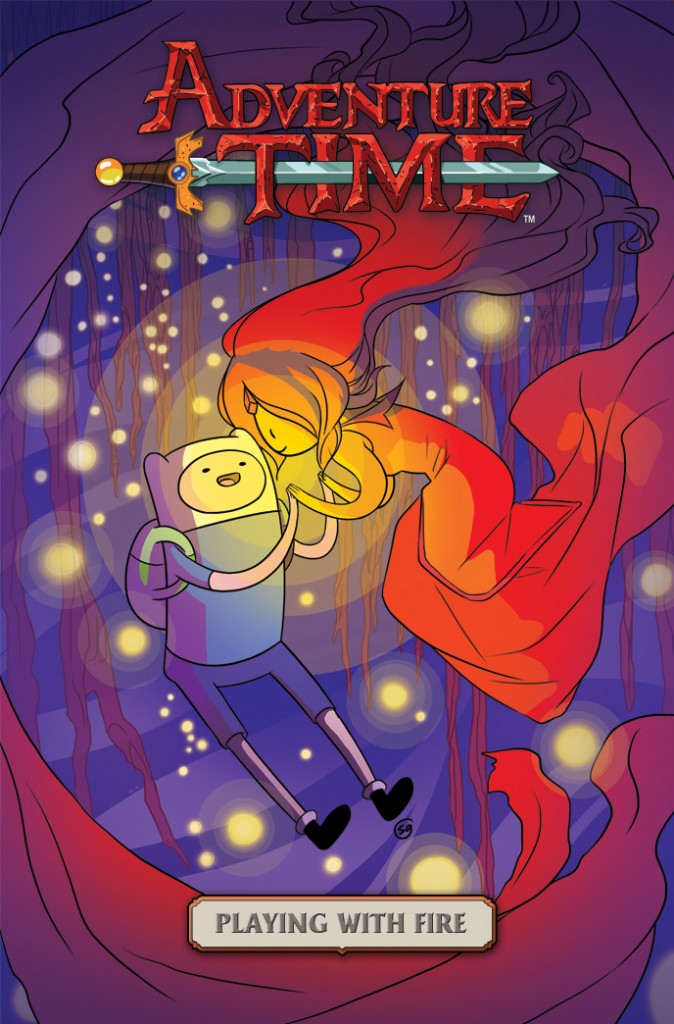
In a way, this is totally unsurprising that Boom! Studio produced another great comic, because that’s one thing they’ve shown a consistent talent for pairing the right writers and artists with the right stories. But this is the publisher’s first foray into the black and white original graphic novels with Adventure Time, and considering that novelty, I was curious as to how the transition would work. And guess what: it worked out splendidly.
Right from the top, the look is really perfectly nailed. Artist Zach Stewart has experience working on covers for the other Pendleton Ward comics, but he really shows off his fluidity and knack for capturing the feel of the show when given over a hundred pages to let loose. It’s especially hard to capture the essence of a world that is, in a very large way, defined by how colourful it is, in a black and white medium, particularly when the other comics to date have matched that colour. It’s to Sterling‘s credit that the mandated black and white palette doesn’t encroach on or limit the feel of the story at all; this is a full-blooded Adventure Time story, with the same chaotic pacing and Kricfalusi-inspired line work. One of the show’s hallmarks is its frenetic pace; things are always moving, but Sterling captures that movement in a static medium in an effective, impressive way.
Danielle Corsetto also sticks the landing with capturing the energy of the Land of Ooo and its heroes; Playing With Fire feels like a really long episode of the show with a twist. All the character voices are there, but she uses the different point of view the story affords to give it a very unique twist.
I love Adventure Time, but because the show is focused on Finn and Jake, not only do most of the episodes focus on them, but the way the secondary characters are shown is usually through the lens of the main characters’ perception. It’s most apparent with Flame Princess, introduced as Finn’s new love interest and now girlfriend, and to date that’s generally how she’s been defined. The episodes with her are mostly about Finn’s side of things. This is one of the strengths of the comics, and Boom! has been great about bringing in different creators to show off the voices of characters like Marceline, Princess Bubblegum, Fionna and now Flame Princess. Corsetto uses an interesting narrative trick to get the big, more familiar personalities of Finn and Jake out of the way pretty quickly, by draining Finn of his soul and separating the concerned Jake from FP. The result is that the bulk of the story doesn’t just include FP, but is from her own point of view, as she confronts some key questions about herself and what she wants out of life. For the first time, we really get to see how she views Finn and what she gets out of the relationship. More importantly, we get to see what she thinks of herself.
The episode “Ignition Point” introduced the idea that Flame Princess, like all denizens of her kingdom, are evil, but the show examined it through Finn’s reaction. Playing With Fire‘s back half is concerned primarily with how she thinks about this, how it will affect her life and her fear that she may be unable to change. It is heavy, existential stuff for a child to be asking herself, but the show is known for doing this, and Corsetto dives deep into FP’s psyche. The result is that we actually get to learn about her, and we get to see her not only be afraid, but work through it using only her own inner strength. The ending doesn’t firmly resolve anything, but it gives a hopeful, if troubled, note. Growing up is hard and frequently traumatic; FP is beginning to change into the adult she’ll one day become, and Corsetto and Sterling guide her and the reader through this very important self-reflection in a way that’s moving, funny and exciting. I like seeing Flame Princess be her own hero.
Special note goes to Meredith McClaren for her backup story, “Adventure Time with BMO.” I was only recently introduced to McClaren‘s work, and this backup story is the first substantial bit of her storytelling I’ve read. It is, simply stated, marvelous. Whereas the main story sticks with the aesthetic of the TV series, McClaren‘s veers off into a more impressionistic, elongated style that gives a fun sense of fantasy the same way the episode “BMO Noire”‘s detective pulp fiction aesthetic did. It defines it very clearly as BMO’s own adventure, and McLaren‘s art is fun, whimsical and incredibly unique. I adore the way she uses white space and plays with the layout to make different page shapes, and her use of emoticons on BMO’s face instead of trying to replicate the staccato style of speech from the series, is exciting. It’s a nice little touch that helps bring the whole thing together. I’d read a whole graphic novel of McClaren‘s Adventure Time art, and I’ll hold out hope that future issues and graphic novels showcase her work again. (J)
This is Comics! The Blog. We now commence our broadcast week.


 James Leask says:
Oh, it's not an issue with your end! You sounded completely...
James Leask says:
Oh, it's not an issue with your end! You sounded completely...
 Kelly Thompson (@79SemiFinalist) says:
Sorry I'm so echo-y! You should have told me I could...
Kelly Thompson (@79SemiFinalist) says:
Sorry I'm so echo-y! You should have told me I could...
 Scotto says:
Literally just read this a minute ago and MAN do I...
Scotto says:
Literally just read this a minute ago and MAN do I...