
Scott or Not: Doctor Who, Series 8, Episode 2
[Ed. Note: After the success of Speed Me Deadly, our weekly Breaking Bad recap series, we're pleased to welcome our friend and colleague Scott "Fill-in host" Williams on-board to talk about Doctor Who. As always, there are spoilers abound in these articles and you should watch the episode in question before reading beyond the header. Geronimo Whatever-the-new-Doctor's-catchphrase-is etc!
Also, we're trying out a new column name since the old one was getting pretty outdated.]
Doctor Who, Episode 802: Into the Dalek
”Life returns. Life renews. Resistance is futile.” – A Dalek’s Midlife Crisis
“You’re evil! And when you try to do something good, you’re even more evil!” – Lisa Simpson
Plot synopsis: The Doctor brings Clara a cup of coffee… with deadly consequences!
———-
Dalek episodes, like Cyberman episodes, are a tricky proposition. A lot of fans who have come to the show in the years since its return don’t really like them, due to their ostensibly one-dimensional identity. But they’re iconic, as well as a convenient shorthand for “opposite of the Doctor.” They’re never going to go away, so it is absolutely imperative that the show’s writers – past, present and future – find new ways to explore them, their means and motives, and their relationship with the Doctor. “Dalek,” for instance, was one of the defining moments of the Ninth Doctor’s tenure. I know a lot of people who, not without good reason, use his “Coward, any time” line, when refusing to sacrifice Earth to destroy the Dalek fleet in his final episode, as the definition of the Doctor’s persona. But, it was also Nine, in the earlier episode, who was told pretty firmly and devastatingly, “You would make a good Dalek.” Spoiler alert: this episode returns once again to the notion that the Doctor and the Daleks aren’t totally dissimilar.
So those of you in the audience who were hoping moral ambiguity would somehow be banished from Who were probably disappointed when the Doctor asks Clara, “Am I a good man?”
It’s a fair question at this point: the Doctor has stumbled into a dilemma where he’s asked to tend to a wounded Dalek by some soldiers who have captured it. Being that the Geneva Convention doesn’t seem to apply to genocidal alien fire hydrants, it would seem to be a case of “kill it fast and chuck it out the airlock,” except the Dalek can’t stop saying things like “DEATH TO THE DALEKS! THE DALEKS MUST BE EXTERMINATED!”
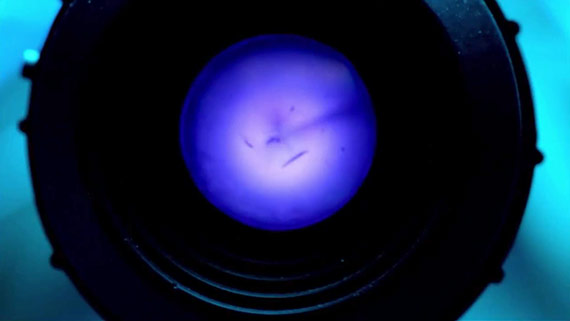
Thus, the premise of the episode: shrink the Doctor, Clara and some redshirts down Fantastic Voyage-style so they can figure out what’s making this Dalek so rebellious. The premise is neat, and it helps that the Daleks are, as we faithful viewers know, organic starfish things in giant oddly-shaped tanks, so they’re really just going inside its machinery, which has certain biological-like components (like antibodies) but isn’t really a body. It doesn’t actually afford us as many awesome setpieces as maybe it could have, but it allows the climactic moment to take place as the miniature Doctor is staring the Dalek in its giant eyeball while Planetarium footage is projected behind him. Whether it’s corny or inspiring depends on what you thought of the episode up to that point. Personally, I’m not even sure where I fall.
As it turns out, this Dalek was driven insane by a combination of radiation poisoning and a bit of a nervous breakdown at the sight of a star being born. “So what?” the Doctor asks, “Stars are born every day. The Daleks destroy stars every day.” Yeah, the Dalek says, but did you ever really think about it? Every time we destroy a star, another star takes its place and the universe keeps going. It’s like, the circle of life, man.
I actually kind of liked that. Again, it’s totally silly that the Dalek would question its entire raison d’etre just because of this, but it’s actually a downright common phenomenon, certainly a very human one, to suddenly be struck by something so ordinary and even to be thrown into a crisis because of it. Also, there’s a radiation leak affecting his brain.
So the Doctor and Clara flip the Dalek’s switch back to evil, (hey, two unrelated Simpsons references in this one!) and then realize “Oh, that was pretty dumb, let’s maybe see if we can convince the Dalek to be good.” And wouldn’t you know it, the thing that convinces Rusty the Sick Dalek to turn “good” is a glimpse of the Doctor’s pure, unbridled hatred of the Daleks. Then he goes on a tear, blowing up the Dalek invaders who are incurring on the base, becoming a hero to us and a traitor to his own kind.
One of the better bits of examination in the episode occurs when the Doctor proclaims he wasn’t the Doctor until he met the Daleks and realized he was meant to be their opposite. Whether he always lives up to that, even in this episode, is the point to debate.
Nothing in this episode is wholly new or shocking. Like I said, the idea that the Doctor is like the Daleks in some ways (mainly his hatred for the Daleks) is hardly new. There’s kind of a sad undertone in the episode that, by and large, if you want to make war on the Daleks, you have to be like the Daleks. You can discuss this amongst yourselves, but it’s worth noting that Twelve, here, was very eager to believe (after Clara talked some sense into him) that the Dalek could be good. It’s just a pity, from that perspective, that that goodness manifests in the form of “blast Daleks instead of Humans.” It’s not the most optimistic view the show has ever taken, but then again one time the Doctor defeated the Daleks because Rose turned herself into Goddess-Queen of the Time Vortex and obliterated them with a wave of her hand, so I guess any victory you can get, huh?
The episode also features Clara meeting a nice young teacher named Danny Pink, who happens to be a former soldier suffering some kind of PTSD, with a side of adorable awkwardness at talking to women. I think he’s a promising new character, and has potential to be, if not as excellent as Rory, a better third for the TARDIS than Mickey. The Doctor himself has ample time to express his own feelings about soldiers: he’s not a fan, although admittedly they don’t seem too pleased with him either. I think superheroes (and for the purposes of this conversation the Doctor is a superheroic figure) often have to kind of be at odds with military and law enforcement personnel, because if they weren’t out there playing by their own rules and using their special abilities and knowledge to get results the military can’t, then there isn’t a show. So you have to address that, and this certainly isn’t the first time it’s come up in Doctor Who. Although… there was also that time the Doctor went to war, and that other time he went to war. The idea of the Doctor as the ultimate pacifist veteran is pretty appealing.
As an exploration of the Doctor-Dalek dynamic, it probably wasn’t as thoroughly satisfying as the premise could have been. The idea of a “Good Dalek” should have had the potential to be the best Dalek episode yet, but something about the delivery didn’t do it for me, perhaps because it was a lot of telling rather than showing, some speeches and a slideshow, and then a bit of obligatory blasting to finish things off. The core idea, that even a Dalek can be redeemed – convinced to fight for the other side – works alongside the general mission statement of the show. But the moral seems to be, “It’s okay to hate your enemy as much as he hates you,” and that’s pretty brutal, even if the Doctor himself feels guilty about it.
But we’re talking about Daleks, the physical embodiment of hate. This isn’t exactly meant to be a commentary on the Middle East. If we can frame the point of this episode as “It’s always worth trying to talk to your enemy,” then I get it. It just doesn’t ride that premise through to its conclusion, leaving us with a Pyrrhic victory of sorts. We’re left feeling a little like Danny Pink: hard things must be done in the heat of battle, things that will weigh on us for time to come.


 Ryan says:
The shoehorned villain that bugged me the most was Catwoman-girl. ...
Ryan says:
The shoehorned villain that bugged me the most was Catwoman-girl. ...
 Devin R. Bruce says:
I absolutely agree that Transmetropolitan is an incredibly smart book that...
Devin R. Bruce says:
I absolutely agree that Transmetropolitan is an incredibly smart book that...
 best of the week: july 24 | Live Within Your Space says:
[…] have some paper piles staring me down. In fun times...
best of the week: july 24 | Live Within Your Space says:
[…] have some paper piles staring me down. In fun times...
 Norman Dale says:
This is an excellent deflationary analysis clearing up some of the...
Norman Dale says:
This is an excellent deflationary analysis clearing up some of the...
 Scotto says:
Man, thanks for sharing. I relate pretty hard right now, I...
Scotto says:
Man, thanks for sharing. I relate pretty hard right now, I...