
C!TB’s Best of the Week // October 21st, 2013

The weekend’s over, but that doesn’t mean the party has to stop. Let’s pump up the funk knuckle to five, kids and oh dear god I’m so very white. Howsabout we talk about some of last week’s best comics instead?

ASK QUESTIONS L.A.T.E.R. (HAHA NAILED IT)
If you had to lure me in with a concept for your story, then “action movie with an ironic twist” would be up there, not far behind “plucky teenage girls start a band.” As a result, S.H.O.O.T. First #1, from Justin Aclin, Nicolas Daniel Selma and Marlac already had a foot in the door. The rest is all execution.
The book is based on a solid foundation of Action Movie Formula, like any good genre story is. You’ve got the team member archetypes, from the nerd to the loner-who-plays-by-nobody’s-rules-but-his-own. The plucky leader. The disbeliefing newcomer. The secret home base. The high tech. It’s all there, and if it were just that, I’d be able to imagine the series not catching much interest. But like any great genre story, the formula is just the jumping-off point for some insanity. And brother, S.H.O.O.T. First #1 has got some of that for you.
It might be the first comic to name-drop and be about secular humanism, and that is just delightful because it takes one of my favourite aspects of action movie formula, being “no-nonsense,” and extends that to the entire concept of the team in a fun way. S.H.O.O.T. doesn’t just fight monsters dead set on bringing about the apocalypse; they fight monsters dead set on bringing about the apocalypse that they also don’t believe in. Other stories have done the “government paramilitary agency fighting supernatural horror” trope well - most notably, the BPRD-verse series that Dark Horse also publishes, but S.H.O.O.T. First carves its own niche by adding a layer of irreverence and playfulness that permeates the whole thing. When the concept is that non-believers are fighting religion-related monsters like djinn and angels, which are things whose existence they fundamentally deny, with bullets that are made out of atheism, the whole thing has a unique wink that I was really excited to see.
Of course, it helps that Selma and Marlac make it a book that doesn’t look like anything else, too. With so much of the supernatural horror genre being defined by Mike Mignola and Dave Stevens’ work, the two do a great job at making sure the book feels unique. I’m a big fan of the way the flatter colours of the characters and monsters are played against the gradients in the background, and how defined the book is by its crisp lines and lack of deep blacks. It makes the action really pop, while also creating a middle ground between the frequent hyperrealism of many action/superhero books and the stylized shadows of the Mignola-verse. Nothing looks like S.H.O.O.T. First, and that helps the book feel unique, too. The first issue handily wins this week’s Elie Wiesel Award for Agnostic Action. (J)
LET’S GET SAD, Y’ALL
I had to stop myself from bursting out into laughter at my grandfather’s funeral. There was nothing funny about the event. I was sitting in the front rows of my grandparents’ church, listening the to preacher or pastor (I decided not to find out which) telling me that I was doomed to toil in the pits of hell. Extended members of my family surrounded me on all sides, and I watched some of the men in our family cry openly for the first and last time I can ever remember. It wasn’t funny. Death isn’t funny. And yet.
People deal with grief in strange and unimaginable ways… when they choose to deal with grief. My gut reaction is to smile and to laugh, because if I can’t do that, then what’s the point, you know? It’s something that seems irrational from a public standpoint. I understand why, but that’s… it’s just my process. It’s what I do.
This is how you write comic book recommendations, right?
Hawkeye #13 was another strong effort from this book’s creative team. While continuing to be a part of a longer narrative, it was an exploration of grief first and foremost. Several issues back, they killed Grills, an affable man who grilled burgers and hot dogs for residents on the roof of Clint’s apartment complex. Despite the fact that he couldn’t get Clint’s superhero name right - or maybe even because of it - we had all fallen in love with the dope. In his brief appearances, he was shown to be kind and caring, able to shrug off the bad whenever it came his way. When Hurricane Sandy was barreling down the east coast, he went out to help his dad survive the storm, even when the old coot was bull-headed and severe. We knew him. We liked him. More than anything, this is why this issue works so well. As Clint deals with his own grief, we are dealing with ours. We’re identifying with a fictional construct of a man, allying ourselves against the outlandishly evil creative team that would hurt Clint in such a way. We’re pulled out from our real lives a live inside the fiction. Only the best creative teams have that kind of effect on people.
Fraction and Aja hand in an incredible comic, building a compelling exploration of grief from a simple nine panel grid. Vignettes unfold over the space of a single page, rarely breaking past the final image and spilling over to another. Clint gets a call. Clint confronts an ex. Clint discovers his loss, and on and on. As we turn pages, we not only fill in blanks left waiting from previous issues, but we see exactly where Clint’s head is at as he drowns in… well, in everything. We see him try. We see him give up. We see him comfort, and we see him push away. We’re there with Clint through it all. We hate and we love Fraction and Aja for doing this to him, those unbelievable dicks.
As always, Hollingsworth offers some resoundingly great work sending the book’s purple palette through some deeper blue tones, the colour matching the feeling. It makes his shocks of bright colours all the more vibrant and shocking when they occur, such as when Clint goes to comfort Grills’ father (a brighter pastel motif, aligning with the time of day, and a sense of comfort) and the deep, disconcerting wine-red of Clint’s dream.
Eliopoulos is at the top of his game too, keeping verbal action within the confines of the limiting nine-panel grid come hell or high water. He somehow manages to avoid covering up any important bits within the story, which shows just how perfectly this team works together, Aja with his strong layouts, and Eliopoulos with a great sense of placement.
Probably the best panel of pure craft happens on the second last page, when Clint is about to introduce his brother Barney to the rest of the building.
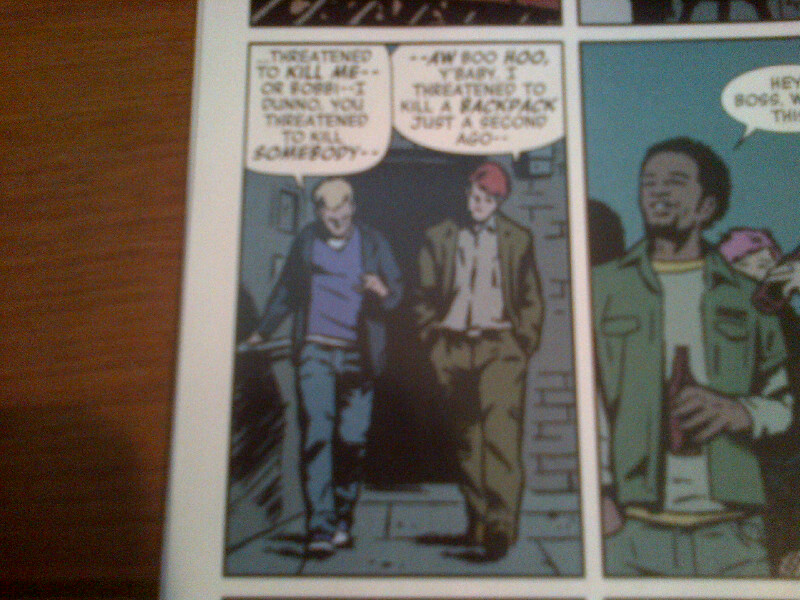
It’s a panel that shows everyone’s strengths: Fraction economically deals with continuity while simultaneously brushing it off his shoulders, Aja composes a panel of two brothers who carry similar body language, identifying them as similar yet different men in such a way that appears to be bereft of detail at first blush. Hollingsworth comes along and absolutely kills the colouring, giving a sense of space to the drawing and finding a perfect edge to switch colours between the wall and the ground near Barney’s feet. Eliopoulos jams the text into the confined space he’s given with apparent ease, stylising Clint’s balloon in such a way that it doesn’t infringe on Barney’s, and so that it’s clear that it happen first. He also manages to space the letters within just right - a bit of a trick, considering what he’s pulling off with the balloons.
This is a book where all members of the creative team are working together to make something great, something important. This is a work that will be held up for years to come, and one that I don’t mind waiting for - especially when we get issues like this, one after another. While I can’t wait for the next one (which will feature art by Annie Wu), I’m quite content to let this comic be what it will be, and arrive when it will arrive. It will make revisiting the previous issues all the more special when all is said and done. Team Hawkeye, naturally, receives our Chet Hunter Memorial Award.
 This is not a book about President George W. Bush and Barack Obama.
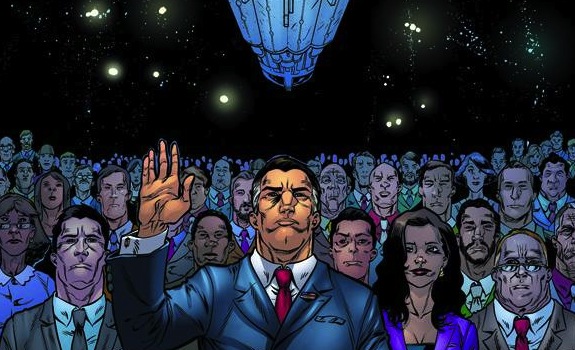
That said, Letter 44 #1, from Charles Soule, Alberto Jimenez Albuquerque and Guy Major, will feel familiar to anybody who paid attention to the American political situation in the last decade and change. In short: a new American president takes office having run for office on a groundswell of support against his predecessor’s aggressive military policy and perceived lack of intelligence in explaining it. He’s immediately availed of some of his cozier ideas, however, when he reads his predecessor’s traditional letter to him and discovers the truth: all the defense spending and military aggression was designed to prepare the nation for its true threat, an alien race amassing a likely weapon in an asteroid belt.
It’s outlandish, but this is maybe the best possible choice the book could make; science fiction has long been a source of political and societal commentary, and the grandiose nature of the threat allows Soule, Jimenez Albuquerque and Major to tackle weighty political issues as transparency, compromise of promises and maintaining one’s ideals in impossible situation - you know, being in high office - with a little bit of distance and plausible deniability. Whether President Carroll and his ranch have a certain familiarity, Letter 44 is clearly telling its own story and, at least through the first issue, has avoided taking sides or hitting readers over the heads with partisan politics. So far, all we have is a tense story and some questions that are going to have to be answered.
The first issue is largely setting the stage for the rest of the series, with Carroll’s letter for President Blades and the introduction of the spacecraft carrying mankind’s first investigators of the threat, but it works because (a) the cliffhanger propels things forward in a giant way and (2) the characterization is so strong; the point of the issue is to acquaint readers with the world and a few of the ideas of the comic, and Letter 44 #1 succeeds by making its cast jump out. The spacecraft’s crew get some open discussion of their situation that helps establish them, but very smartly, Blades is defined by his quietness and the barrier between him and the readers. He’s in a situation where he can’t play all his cards - if he’s even made up his mind yet, which isn’t likely - and so Jimenez Albuquerque and Major shoulder the load admirably conveying his character through the art, in particular an extended scene where he’s reading. Major‘s colours deserve special notice here for the mood they set, with the deep blues and greys of the space half the story marrying well with the dark shadows, literally and figuratively, of the political half of the storyline.
The ongoing challenge of the book will be to make sure that neither half of the story gets shortchanged, from the science fiction half in space to the West Wing-y half in the White House. So far, the book’s team have given the series a lot of promise, as well as a dark glower of a mood. Can ideals be maintained in these kinds of situations? Let’s find out. (J)


 Scotto says:
Fact: "Baby When You're Gone" is literally the only thing Brian...
Scotto says:
Fact: "Baby When You're Gone" is literally the only thing Brian...
 James Leask says:
Oh, it's not an issue with your end! You sounded completely...
James Leask says:
Oh, it's not an issue with your end! You sounded completely...
 Kelly Thompson (@79SemiFinalist) says:
Sorry I'm so echo-y! You should have told me I could...
Kelly Thompson (@79SemiFinalist) says:
Sorry I'm so echo-y! You should have told me I could...