
Hindsight // Time for The Flash
The days are long, but the years are short.
This is a thought that has been running around in my head more and more frequently as I age. The reasoning behind that should be apparent to anyone who has pushed past their mid-twenties: while time seems to drag while you’re in experiencing it, the past seems to be stretching out farther and faster than it ever has before. It can be disconcerting, especially when you look at what you’ve accumulated over the years, or worse: what you have yet to accumulate.
This month, I will begin my eighth year at Wizard’s Comics in Edmonton. In January, I will be starting my sixth as the store manager. Despite the fact that I felt every single minute of working in that store, from this angle, it seems like an impossible amount of time. Working in the comic book industry has its own special way of distorting time, as your days are plotted like a strange form of clockwork. On Tuesdays, you process shipment. On Wednesdays, the new comics hit the shelves. On Thursdays, you enter invoices and catch up from Wednesday. On Fridays, you ready the store for a Magic tournament, and on and on and on. While the experience varies from store to store, the general effect is the same. Your life starts to develop beats and cycles. You run through the cycles, hit your beats, and continue on and on, week after week, hardly realizing that these weeks are slowly becoming months, which are slowly becoming years, which might one day coalesce into a decade or two. Time runs away with you. I’ve come to discover that this is both a blessing, and a curse.
“HINDSIGHT”
A series wherein we use the time and life experience we’ve been given to revisit old favourites with fresh eyes. When you’re mired in the crush of the weekly comic book grind, it can be easy to get lost in the minutiae of the moment, where continuity is king and the reverberating effects of events inside real and imagined universes deeply affect our enjoyment of single issues. This is a series where we take a look at older issues outside of the context of time and space and experience them for their current merits. It will also give me a good excuse to dig through the backlog of things I need to read and use that time to create content. So.
The Flash Vol. 2 #62
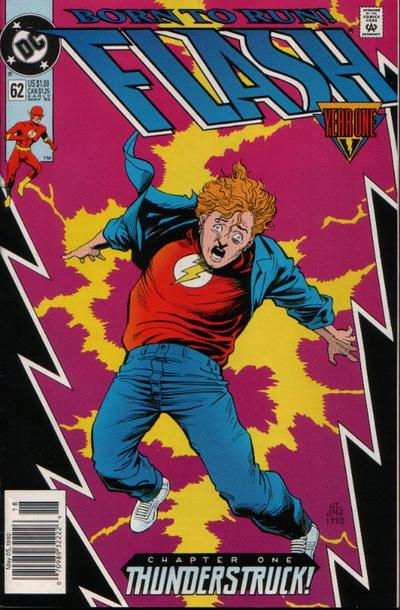
The issue opens with Wally West in full Flash garb running towards the reader in a big splash page, talking about a funny joke he heard about two terrorists in police custody. One tells the other that it might be a good idea to let the authorities know about the bomb they planted in the Central City airport before it blows up at twelve midnight. The second terrorist turns to the first and says “Twelve midnight?! I thought you meant twelve noon.” In a single page, Waid not only launches the book into a great “proof of concept” race against the clock, but he establishes Wally as a man with a dark sarcastic wit. It’s an economical page that accomplishes so much. The announcement of Waid as the new writer in the lower left corner of the page almost seems redundant as the work has already done so: this is the start of something special, something new. This is where The Flash begins.
As the scene plays out, we get a great sequence of Wally vs. Time. He has eight minutes to somehow find and diffuse the bomb and save the day, and he’s doing his very best, checking every place he can think of. Given a few more minutes of notice, he knows he could probably check the whole airport, but under such constraints, he’s going to need more than just super-speed to accomplish this feat. In another great character moment, Waid has Wally pause ever so briefly to think about the problem critically, which results in the day saving gambit. The whole opening is a succinct statement on what this book will be, and who Wally will be within it. It’s a brilliant bit of storytelling and a near perfect way to introduce a character and a run.
With the opening taken care of, Waid relaxes a little and takes us back through memory lane. He makes sure we know the important bits, like how Barry was the first Flash, how Barry had married Wally’s aunt Iris, and how the two of them were no longer around. Waid then sets Wally up against his grandpa Ira West, and triggers a walk down memory lane that includes the superhero origin of Wally West. At this point in time, I don’t think this had been revisited in any substantial way since Wally’s introduction as Kid Flash years previous. Regardless, the re-introduction is well timed, allowing all newcomers a chance to meet their hero for the first time, and for all older readers to experience the moment in a brand new way. Back in the silver age, where Wally was first introduced, comics were produced at a fast clip and little attention was paid to story craft. The main goal was to get out content in any way that you could, and as such, many origins were brief and lazy. In Wally’s case, he was given Barry’s own coincidental origin - a combination of lightning and chemicals washing over his body - and powers. It’s one of those situations that induces eye rolls when the mind has grown cynical. Amazingly, Waid doesn’t change that moment, opting for things to unfold as they always had - coincidence upon coincidence, lightning striking twice. Instead, he shines a bright light on Wally’s life up until that moment in time, which had been lost in the relative brevity of storytelling in the silver age. We discover a tough childhood lifted by his relationship with his Aunt Iris. We see his dumbstruck awe in meeting and helping the Flash, and his abject boredom at having to deal with his aunt’s boring fiancée Barry. We get to know Wally as a person and learn to care about him before the lightning strikes for a second time and makes a second Flash. He makes us care enough that we’re not too bothered by the coincidence. We want this young man to grow up and become the Flash. We want Wally to be our hero. He has to get there - and he will.
This issue is the first part of what looks to be Wally’s four part origin story, going from his formative moments, through to the end of his first year. I will admit that I have yet to read more than this issue of Mark Waid’s run, so I’m not quite sure how the rest of it goes, but if the reputation of the run and this first issue are anything to go off of, I know I’m in for a great ride.
I’ll periodically be checking in as I read more issues, with shorter articles to let you all know how things are progressing, hopefully mapping out a solid running critique of his run as a whole. If you’d like to follow along, you can purchase the first issue at ComiXology for $1.99 and you can go from there.


 Scotto says:
Fact: "Baby When You're Gone" is literally the only thing Brian...
Scotto says:
Fact: "Baby When You're Gone" is literally the only thing Brian...
 James Leask says:
Oh, it's not an issue with your end! You sounded completely...
James Leask says:
Oh, it's not an issue with your end! You sounded completely...
 Kelly Thompson (@79SemiFinalist) says:
Sorry I'm so echo-y! You should have told me I could...
Kelly Thompson (@79SemiFinalist) says:
Sorry I'm so echo-y! You should have told me I could...