
Best of the Week // Unreality Television

It wasn’t supposed to be about a murder arena.
Before closing the book on Avengers: Arena, Dennis Hopeless took the opportunity to tell readers just how the book happened. As it turned out, Arena was meant to be the third arc in a series that closely resembled what Christos Gage had been doing in Avengers Academy. When his editor saw what was handed in, there was a push to make Arena the main focus, taking a set piece, and blowing it up as large as the current market would probably allow. This naturally came with a set of problems in and of itself - the biggest of which was going to be reception.
When you announce the potential deaths of a handful of beloved characters, you’re going to upset quite a few people. Forget the fact that the book has yet to be fully produced, and forget about execution and intent. With the smallest whiff of information, people will begin to write their own stories and judge creators for the results. It’s unfortunate, but I get the impulse. I’ll admit to doing it as well as the cast was announced, and I saw two members of my beloved Runaways on the murder island alongside Juston Seyfert, the main character of Sentinel. A pit in my stomach grew exponentially as I began to write the edges of an experience. I told myself that I wouldn’t like this book. I bought it and read it anyway, and the results were quite surprising. It wasn’t that book I thought it was going to be. I doubt it was the book anyone thought it would be, right down to Hopeless, who had pitched the series quite differently to start. That said, it’s rightfully become a hit among those who gave it a chance and rode the series through to the end. It was rich with character, and didn’t glorify death or use it as cheap fodder. Moments were earned through a lot of heavy lifting wherein Hopeless condensed all the character building he was probably going to do in the first two arcs of his original pitch, and had it happening concurrently alongside the “third”. The results were stunning - and I’m so glad that Marvel is giving him a chance to follow-up on the close of Arena with Underground.
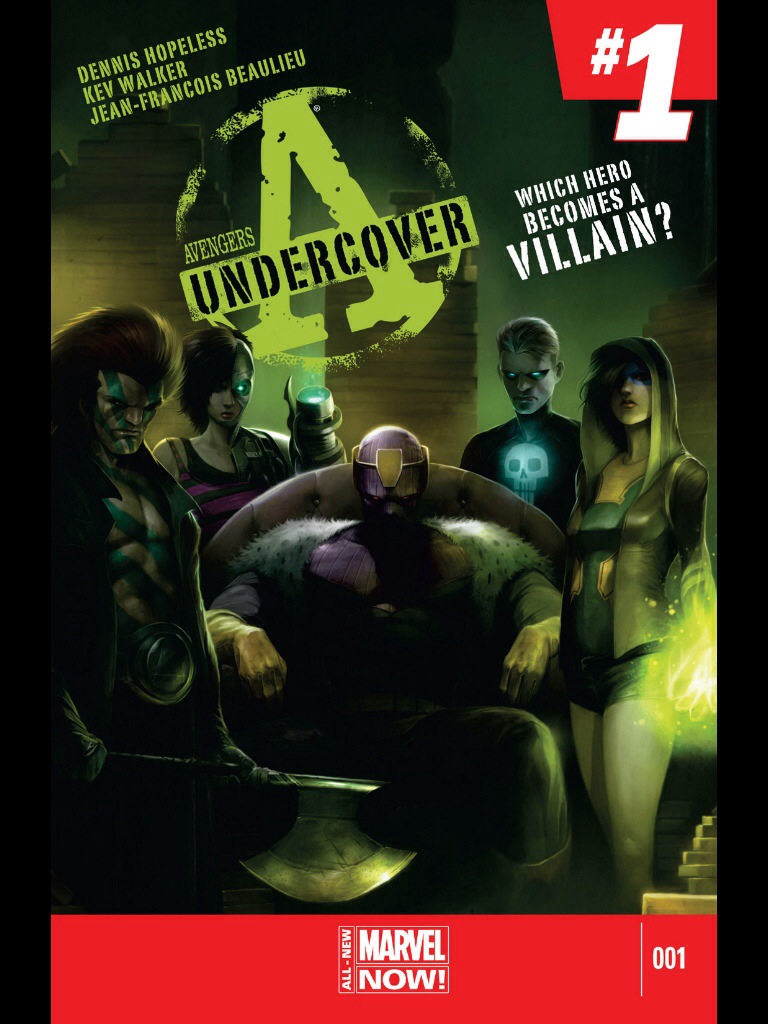
art by Francesco Mattina
There’s a lot to like about this first issue. Kev Walker - the artist for the bulk of Arena, returns alongside Hopeless and delivers some of the best work I’ve seen from him. The bulk of this issue deals with a lot of emotional bits of aftermath as we drop in on the majority of the survivors and see how they’ve been coping with the events. Walker’s renditions of the wide variety of emotions, from boiling rage to lackadaisical apathy, really sell the beats Hopeless is hitting in the script - and boy, are they some great beats.
My two favourite parts of the book essentially cannibalize fan reaction to the series, and use it as bizarro fodder in the comic itself. This starts right at the top as Hazmat deals with a jerk who is loudly talking to his friends about how he thought she was the worst combatant on the murder island. He talks about what he would have done in the arena in her situation, feigning greatness in the face of zero consequences.
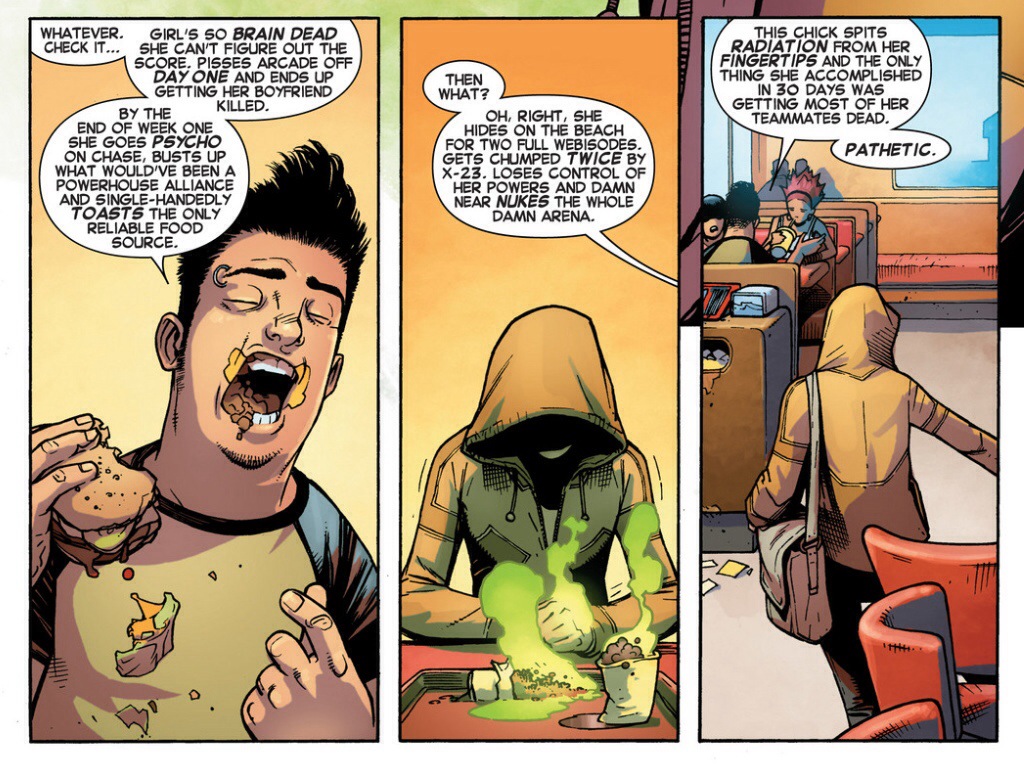
art by Kev Walker and Jean-Francois Beaulieu
Of course you can be the hero when you’re armed with hindsight and an absence of all threat to your life. After all, we’re all the heroes of our own stories, are we not? I’ll come back to this idea in a bit, I just want to hop over to this second bit.
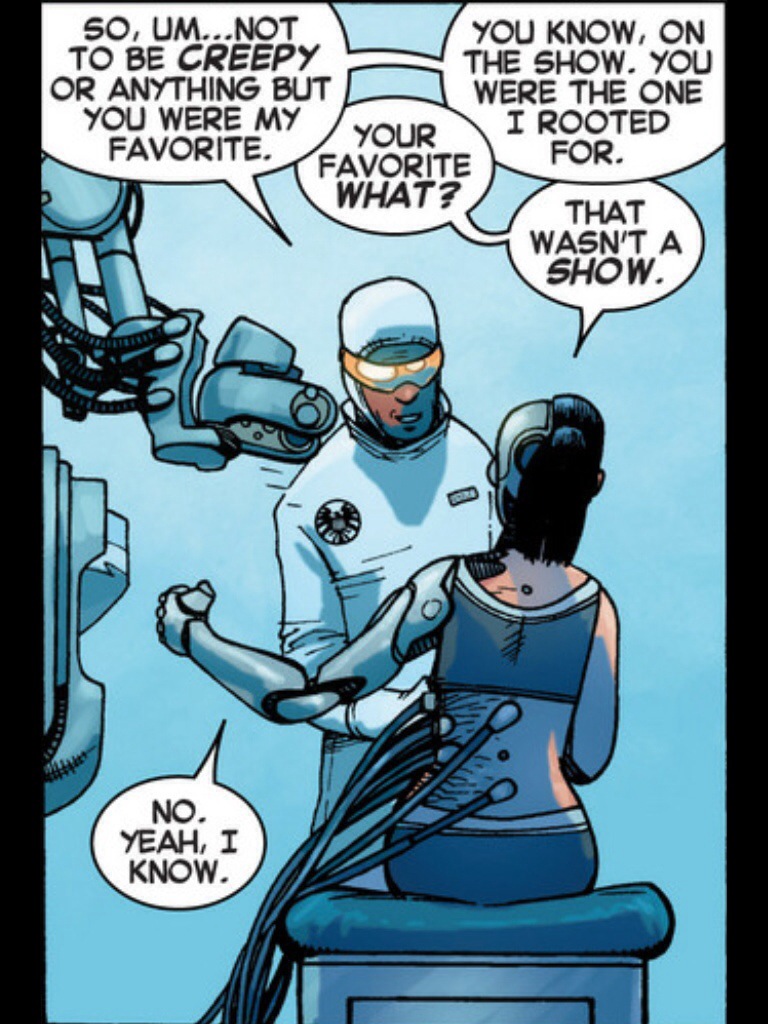
art by Kev Walker and Jean-Francois Beaulieu
Here, a SHIELD agent is talking to Deathlocket about how she was his favourite character on the show. He’s very careful to not say character, but the implications are clear. He’s making the mistake of confusing real life horror with entertainment, an indictment of reality television writ large with superhero metaphor.
These two moments reverberate from me so well because they resemble a large portion of my life in the comic store. There are a lot of people who can’t seem to differentiate what is fiction and what is reality. Arena invoked a fair amount of this broken look at reality with people ascribing the realities of life and death upon fictional characters, while subjecting the creators to a litany of death threats and other bits of ephemera for what they were doing to very unreal creations. They were treating the fiction as though it was real, and threatening real people as though they were fictitious creators. These two scenes are essentially that, only slow cooked in a hard candy shell of fictitious super-heroics, a hard pill made easier to swallow by the fantastic. They made me smile more than any other moments in any other comics this week, thus earning this book and its creators this week’s Shit’s About to Get Hungry Award. Congrats or something!


 iv says:
I like licensed comics but you might say all I read...
iv says:
I like licensed comics but you might say all I read...
 Laury Plant says:
Joe Mangianello. Well played. Exceptionally well played.
And I still await your...
Laury Plant says:
Joe Mangianello. Well played. Exceptionally well played.
And I still await your...
 Scotto says:
Here you go B., you didn't hallucinate it: http://www.rollingstone.com/music/pictures/gallery-the-best-break-out-bands-on-rolling-stones-cover-20110502/britney-spears-1999-0973071
Scotto says:
Here you go B., you didn't hallucinate it: http://www.rollingstone.com/music/pictures/gallery-the-best-break-out-bands-on-rolling-stones-cover-20110502/britney-spears-1999-0973071
 Scotch & Comics Episode 021: Let’s All Have Some Cake | Scotch & Comics says:
[…] a link to my column on Comics! The Blog. It’s...
Scotch & Comics Episode 021: Let’s All Have Some Cake | Scotch & Comics says:
[…] a link to my column on Comics! The Blog. It’s...
 Brandon Schatz says:
You recently got me on a big Lake Street Dive kick...
Brandon Schatz says:
You recently got me on a big Lake Street Dive kick...