
Hello! Long time no see! Well, it’s been a week, I suppose, so not that long. It feels like longer, though, because I crammed so much activity into my long weekend that it feels like it’s been more like … nine days. Ten at the most. This week I’ve decided to talk about a difficult genre when it comes to comics, a genre that has been very popular in the past but now seems a little dated: war comics.
* * * * *
Garth Ennis’ Battlefields: Not Your Father’s War Stories
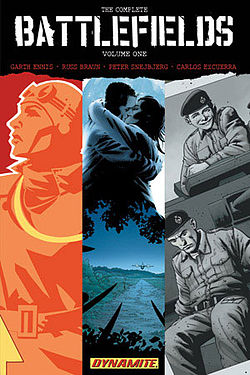
As a genre or subject of a story, war is a tricky one. If it glorifies battle so much that I start feeling like it’s something to aspire to, I get extremely uncomfortable with the politics; if it is a relentlessly depressing tour through a meat grinder it can become overwhelming. There are a few works in every genre, though, that I feel are good enough or important enough to explore. Insomuch as it is good storytelling with compelling themes, I feel that The Complete Battlefields Volume One is one such work. Writer Garth Ennis does not shy away from the darker material, either in his mainstream work with such series as Preacher, Punisher, and Hellblazer, or his smaller titles such as Crossed and The Boys. I am no great fan of either of those last two works, but overall he’s a writer I like, and when he’s passionate about a project I have to at least check it out. The Battlefields stories for Dynamite, published in 2009, are definitely a passion project, where Ennis pairs up with different artists to make a series of three-issue stories about different aspects of the Second World War. Each story focuses on different characters, on different fronts and on different sides, and not only does Ennis tailor his stories to the individual talents of his artists, he shows that war stories can have depth and breadth, and don’t have to simply be cautionary tales, thoughtless adventure stories, or jingoistic propaganda.
The first series, The Night Witches, was illustrated by Russ Braun (Jack of Fables; The Boys; Legends of the Dark Knight). The Night Witches were a group of Russian pilots, a bombing regiment whose job was to disrupt the actions of German troops. They were also an all-female regiment, something that doesn’t necessarily sit well with the male troops, whether they were Russian or German (the Germans were the ones who gave them the nickname in the first place). The perspective shifts back and forth from the Germans to the Russians, and I appreciate the dual perspective and how the reader is allowed the opportunity to see the Nazi soldiers as human, even though as the story progresses, some of the characters reveal themselves to be barely human. The last series, Tankies, is the lightest and closest to funny as Ennis gets in the collection, but as with the best of Ennis’ stuff, the humour is there so it’s that much easier to cut the legs out from under the reader. Tankies is illustrated by longtime Ennis collaborator (and co-creator of Judge Dredd) Carlos Ezquerra, whose talent for creating distinct, memorable faces as well as scenes of real brutality are put to great work. Tankies is a little light, story wise, but I will take a slightly weak script illustrated by Ezquerra over a strong script illustrated by a far lesser artist any day.
The collection’s crown jewel is the heartbreaking and horrifying Dear Billy, a wartime romance after a fashion, illustrated by Peter Snejberg (Starman; The Books of Magic; A God Somewhere). Dear Billy starts with a shot of a group of British women who, after being kidnapped and abused by Japanese soldiers, are marched into the ocean, shot, and left for dead. The lone survivor, a nurse named Carrie Sutton, is recovered by British soldiers some time later and brought to a hospital to recover. Soon after her recovery she is recruited to work in the hospital, where she eventually meets a charming and handsome pilot named Billy Wedgewood. Over the course of the story Billy and Carrie begin a wartime romance. It sounds sweet and tragic, but this is a Garth Ennis comic, and he has no interest in telling an uncomplicated love story. See, the day Carrie was left for dead by the Japanese soldiers, something changed inside her. She broke open inside and became someone else, something else. Someone who hated all Japanese people, who wanted them all to suffer and die, who could never forgive the horrors she had to live through. And thanks to her role as a nurse in a wartime hospital, she is able to fight her own secret war against the Japanese prisoners of war who come to recover at her hospital.
The story is unbelievably powerful, even more so because of how it’s told. Narrative boxes reveal Carrie’s letter to Billy as she tries to explain to him in this too-late letter what she never could in real life. The budding romance between Carrie and Billy is sweet, but undercut by the secrets they are keeping from each other, and Carrie’s need to play into the role Billy has cast her as his “naive young nurse.” The characters are deep and rich, even the supporting characters — the scenes where the couple go out drinking with Billy’s two American pilot friends are real standouts — and after the grotesque opening scene, the horror and dread are played with remarkable restraint. Snejberg’s work on Dear Billy is also tremendously powerful in its quiet confidence. He uses shadows and silhouettes for visual emphasis and rarely clutters his panels even when there are people being torn apart by bombs and gunfire. The art seems almost simplistic on first read but it’s really the work of a skilled craftsman who knows exactly how effective the change of a single line can turn a face from wistful to vicious. It’s probably clear that Dear Billy is my favourite of the three stories; it’s a smaller, quieter war story, and I also like that it’s told from the perspective of a smart, capable woman. Her private war, her private hate and her inability to either communicate it or let it go, is ultimately the thing that destroys everything she cares about. It’s romantic, it’s personal, and it’s horrific.
I know war comics are not everyone’s cuppa; hell, it’s not always mine. But these stories work because Ennis has real love for the genre and has important stories he wants to tell. And with the art talent that he’s assembled, it’s well worth a reader’s time.
* * * * *
It wasn’t all brutal, beautiful war stories this week. There were also a couple of season finales that I felt merited a mention.
Television: The season finale of The Flash exceeded all of my expectations. I’m not going to go in-depth into any plot points or story elements, but I will say that I felt the episode gave practically every character a story beat that tied in with their season-long arc. It also set up some very cool story possibilities for the next season, with a couple of surprises for the nerds (if I could sum up my feelings on this episode in one word, that word would be “HELMET!!!!!!”). The show made me gasp in surprise, pump my fist in triumph, and tear up a couple of times. I hope the inevitable future comic-based series take their cues from this show and from Agent Carter — not in the sense of thoughtlessly emulating them, but by realizing there’s more than enough room to give their shows a tone that’s different than “goofy” or “gritty.” There’s plenty of room in between those two, and beyond them as well.
Television: After watching the finale of Brooklyn Nine-Nine, I wanted to take a couple of sentences to stump for the show. I’m not sure how popular it is; it won two Golden Globes last year so it’s at least a critical success, but then again so was 30 Rock and that was decidedly not a popular show. If there’s anyone out there who’s not watching it, all I can say is that it’s a workplace comedy with a solid ensemble cast including the phenomenally talented Andre Braugher who is the highlight of over 90 per cent of the episodes (this can be proven by science if need be). He completely commands the best moment of the finale, unsurprisingly, and it’s a sheer delight to see him onscreen. Hell, the show is so good I can’t hate Andy Samberg any more, and boy howdy did I used to hate Andy Samberg. I really recommend fans of smart comedy catch up over the summer in preparation for what promises to be a killer third season.
* * * * *
Two television shows and three war stories is about all for me this week. Until next time, read something by Peter Snejberg. Every time I see his art, I want to see more of it. I’ll see you in seven days.
