
Digital Distribution & Piracy: Now with Extra Impatience and Entitlement!
[Ed Note: If you haven't read my Friday article on downloading or the links at the bottom of it, you might want to do so first.]
Ever since the first file-sharing sites came to the attention of college students and teenagers everywhere in the late 1990s, the spectre of piracy has shaped much of the entertainment industry. On one hand, there are the giant companies of the industry itself arguing that this change has been almost unequivocally for the worse, with countless millions of dollars in sales lost to pirates. On the other hand, you have people arguing - supported by a not insignificant amount of non-partisan research, I might add - that while some piracy is bad, overall it’s not related to a loss of sales because it can actually encourage sales by letting people try things out & discover things they like.
Personally, I find piracy distasteful. Now, I’m not saying it’s actually harmful, I might add. There are certainly people who use free downloading options - legal or illegal - as a way to sample things and discover media that they genuinely want to pay for. It’s certainly hard to argue with the growing wealth of research that finds illegal downloading correlated with actually buying media. I know people who download illegally, as I’m sure we all do. Some of these people do so when there is no legal option, due to broadcast restrictions or something simply being out of print. Some of the people who download illegally that I know are actually ones who spend the most money on media because after, say, watching a video on a 13″ laptop screen what they really want to do is rewatch it on a bigger TV or on a movie screen. There are also people who are, simply put, thieves. They’re not going to pay it’s arguable that they never were anyway, so the industry isn’t exactly losing a purchase.
However, one interesting result of the advent of digital piracy is that it’s forced the entertainment industry to explode in terms of the sheer wealth of consumer options available. For all its possible ills, piracy made it necessary for companies and content-owners to start selling digital content because if people were going on their computers to watch, play or listen to something, they might as well be able to pay for it. To that effect, I’d argue that piracy has been the single biggest catalyst for industry and media distribution changes since home media. If you’ve ever bought a song, TV series or movie in iTunes, watched something on Netflix, played a video game’s downloadable content or streamed something to your TV that you bought on your computer, I’d argue that it’s fundamentally because sometime around the turn of the millenium, people figured out how to steal in a more efficient way than ever.
Like I said, these days it’s not as simple as “theft.” I firmly believe that, with the right price point and amount of ease, most people will pay if they’re given the option. The success of digital distribution companies is certainly a good argument in favour of this. The problem, however, lies in the fact that “ease” is such a variable definition with such an escalating consumer expectation, as evidenced by a recent comic from Matthew Inman, aka The Oatmeal. Last week, he posted a comic titled “I tried to watch Game of Thrones and this is what happened“:
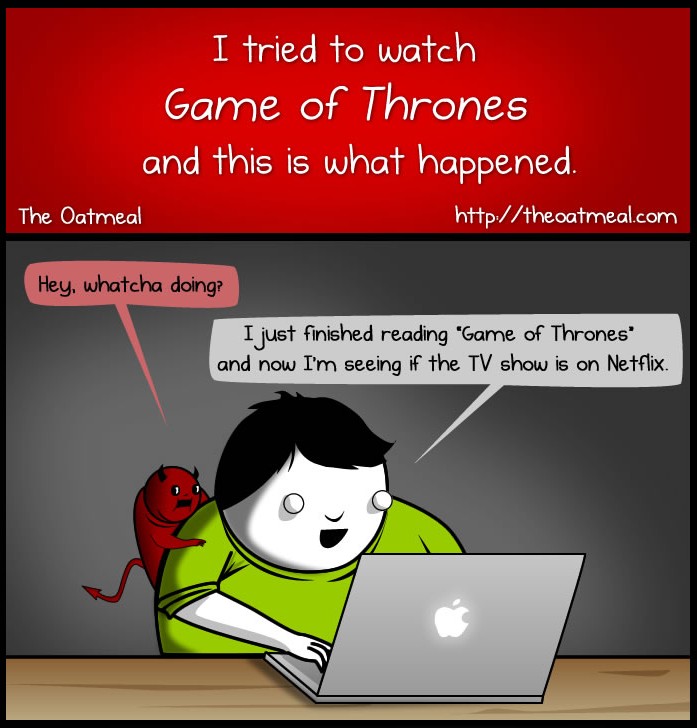
Click to read the whole thing at his site! (Copyright 2012, Matthew Inman)
In the comic, Inman describes his recent effort to watch HBO‘s series Game of Thrones and his continual frustration at being unable to do so legally, culminating in his decision to pirate it despite his initial reluctance. In the week since the comic was published, the strip has been raised as a banner by consumers as a symbol of consumer’s rights and why corporations should let people buy things as quickly and easily as possible, lest people turn to piracy.
I get that, I really do. For the record, I believe that HBO and other companies should let customers buy things early, because when so many TV series are available to stream or purchase a day after they initially air, not doing so is a license to pirate for many people. HBO will likely be the last holdout for this, primarily because they’re the most prominent subscription cable channel out there and if people can buy a series on iTunes or stream it on Hulu for free the next day, there’s no real incentive to subscribe. It’s the same reason why they do things like release the DVDs for Game of Thrones a frustrating nine months after the first season completed; if subscribing to HBO is the only legal way to watch the series, they’ll hold onto that for as long as possible. I think that’s stupid precisely because people will just do what Inman did, and HBO will eventually be forced to change their practice once they’re convinced it’s more profitable to do so.
In this regard, Inman makes a compelling argument as an example of what the consequences for not selling something relatively quickly are. My problem is that he’s making a poor argument in, at best, bad faith. At worst, it’s outright dishonesty.
Inman‘s comic is expertly crafted to relay his argument. It draws a straight line from “I want to check this out” to “I don’t want to steal it” to “They won’t let me buy it”, finally arriving at, “They forced my hand, I guess I will steal it.” It’s based on two primary arguments:
(1) He can’t buy it now;
(b) Who knows when he will be able to buy it (as evidenced by the “availability date unknown” part of a Netflix window he highlights in the second panel)?
My problem here is in what he excludes or ignores. Netflix is a great place to start because it is the most likely place to not have what he wants available, due to one simple fact: the series hasn’t been released on DVD yet, so of course Netflix can’t send them to him! It’s also the place least likely to have a release date because unlike a retailer or rental place, a Netflix release date isn’t as simple as the DVD release date. A release date that is, for the record, March 6th, 2012, which anyone who Googles it or goes to Amazon can find out:

Inman isn't the only one who knows how to highlight text!
This automatically undercuts Inman‘s argument and, since he includes a different Amazon screengrab in his comic, it’s hard to imagine that he didn’t think to do a general search for “Game of Thrones” instead of just one for Instant Video. Even more damning is the fact that in the fifth panel he declares:
“I’m committed to buying this thing!”
And then proceeds in the very next panel to disprove his statement by ignoring an option to buy it. When I discussed the comic with friends, several said some variation of, “But he couldn’t buy it!” at which point I reminded them that he posted an image of a Buy button in iTunes and showed them this:

This is the image I got after I bought the series.
This is, ultimately, the core of my disagreement with Inman. It’s one thing to present a potential and popular justification for piracy - which he does brilliantly and to great effect, I might add, because he is a perceptive and talented man - and another to be outright dishonest by saying you’re “committed to buying” something and then taking literally the first out you could possibly have. I’ll reiterate: you can buy Game of Thrones. I know that because I bought it. What Inman should actually have said in order to be less, you know, lying, was that he can’t buy and watch it immediately, which is a dealbreaker for him.
I understand that because, much to my lasting embarrassment, I actually pirated the first season of Game of Thrones myself, after missing its original broadcast run. Eventually, the only way I could justify downloading it illegally was by making myself a promise: no matter what, I would pay for it eventually and delete my illegal copy as soon as I’d watched it. If I liked the series, I would buy it. If I didn’t, I would pay to go down to The Movie Studio, an amazing local video rental store, and rent it on Blu-Ray because I torrented it in HD. In the end, I bought the series and subscribed to HBO for the upcoming second season of the show. And yes, I illegally downloaded first. I am genuinely embarrassed that I couldn’t wait to pay for it, and I’m trying to present my own rationalization, as flawed as it was, as honestly as I can. My frustration with Inman‘s argument is, to a significant degree, because I perceive his argument to be fundamentally less honest, for the reasons I’ve given.
When I brought this up with friends, all of them rebutted with the argument that HBO was asking an inordinate amount of time to wait for a purchasable copy of Game of Thrones and that it was, frankly, stupid, because people like Inman would just pirate it as a result. I’m not saying they’re wrong. In fact, as I repeated emphatically to them and have tried to here, I agree. I just think Inman‘s specific example is a poor one for this because he didn’t put up this comic nine months ago; he put it up a week ago, when he’d only have to wait two weeks to watch any copy he bought. The screengrabs he includes in his comic could only have been made recently, and that’s a big part of why I differentiate between him and myself. He might buy it eventually. He certainly won’t subscribe to HBO because he says he won’t, and when HBO doesn’t put the second season up on iTunes or Netflix 9 months before DVD release date, his current argument would lead to the same conclusion. HBO and Inman are both complicit in this, but only one of them is technically in the legal wrong.
As I discussed this issue, I got accused of focusing too much on Inman and not on the broader issue of digital distribution release dates. I did focus on his example, and I did it for a very clear reason: to me, his example embodies the worst elements of the current audience that’s used to and who demands digital distribution: entitlement and impatience.
I understand both of these, to some degree. I downloaded the series myself because I didn’t want to wait 9 months and because I had dedicated myself to paying for it down the line. I was impatient, and to a certain degree, entitled. I took something because I could and no matter how I justified it, I can’t escape that I ultimately did it because I wanted to. This… is not a good quality to have.
Here is the core difference, as I see it: when I downloaded the series, there were literally no ways to purchase the series. When Inman did it, there were several ways to buy it. He said he was dedicated to buying it, but it turns out that dedication was only as strong as the first minor obstacle. What he is saying isn’t, “I am dedicated to buying this.” What he’s actually saying is something far more insidious:
I am going to watch this anyway. Whether or not I give you money for it is dependent on whether you do exactly what I want, when I want it.
This isn’t the action of a customer. It’s the action of someone who’s looking for a reason, any reason at all, not to be a customer. He’s holding his payment hostage, and that’s a practice I abhor in a certain segment of consumer these days, the type of person that is always and primarily a consumer, but less often a customer.
Say what you will about the limits of pre-digital distribution, it drew entitlement into stark contrast with a purchase. If you wanted something but didn’t want to pay for it, you had to actually steal it with your hands. With digital distribution and piracy, however, it’s a lot easier to avoid paying and it’s a lot easier to justify it. Here’s my take: if you watch something, you’re generally obligated to pay for it if you can. If you’re not willing to pay for it, you’re not entitled to take it just because you can shore up an argument printed on the Jolly Roger. If I walk into Brandon’s shop, I don’t think I’m entitled to have any comic I want and pay him only if I think the price is right. If I want it, I pay for it, and that’s something I try to follow in the digital world.
The danger of Inman‘s argument is that, as it is crafted, it is quite compelling until you look at it in depth. In a short week, people have started to rally behind it, but they’re rallying behind an argument that’s not entirely forthright and makes some dangerous justifications. I look forward to a day when you can buy or stream almost any show the day after it airs, where paying for something is easy and expedient. That’s a future, I think, that is hurt by the argument that stealing is preferable to waiting two weeks or even two days. There’s no reason to deal with someone who isn’t being honest, who will say one thing while doing something completely antithetical to it. Whether or not Inman eventually buys Game of Thrones, he’s convinced a lot of people he’s right even if he doesn’t, and that scares me.

It can be a very slippery slope, as you illustrate, especially as it pertains to release dates. Weirdly, the sense of entitlement doesn’t extend only to pirates.
I had a customer the other day find a copy of Pink Floyd’s The Wall on the shelf without a price. He went to ask my manager what it cost, and she told him, but didn’t notice it was the 3 disc version that is not being released until tomorrow. When he brought it to my register and I informed him that I could not sell it to him, he got pissy, asked why nobody said so sooner (answer: a simple mistake, these things happen, etc) and refused my offer to put it aside for him until Tuesday, saying “I don’t think I’ll be coming back.” In fact, he stormed out and then returned to inform my manager she had “wasted his time” and even sent an e-mail to the company’s Customer Service department informing them that “Although (he) enjoyed buying CDs, we were in danger of losing a customer over this,” and that he would probably get an iTunes card and download it that way.
And, y’know, fair enough, but he still can’t hear it until Tuesday. It’s nothing to get mad about. EMI is still getting their money and I doubt we’ll have a problem unloading 5 copies of The Wall. He was basically calling us cockteases because we accidentally almost let him buy it.
I realize this doesn’t have much to do with your argument, but it reminded me of the incident, which as I said literally JUST happened, and is at least a little indicative of the attitude you describe, if a less harmful version.
Well written argument - I used to download everything in my youth but now that I have some stableish income and a sense of responsibility to compensate people who’s products I enjoy I buy my music and comics go to the theatres often etc etc - but still download some shit - events if its just because I missed the airing of it on TV.
Anyway I just wanted to add also that you cannot argue with oatmeal, that hearty cereal grain has sustained mankind for centuries and asked nothing in return.