
Every week, Comics! The Blog goes through the list of new releases and we tell you which comics to plug into your mindhole. Your mileage may vary.

Every week, Comics! The Blog goes through the list of new releases and we tell you which comics to plug into your mindhole. Your mileage may vary.

Hey people! No time to talk! We liked comics last week! You liked comics last week! Is this a connection I feel? We should hang out sometime, just you and I-no Brandon I will not stop using the site as my own personal dating service
Recently we announced that we’ll be co-presenting a screening of Josie and the Pussycats along with Graphic Content at The Metro Cinema at the Garneau Cinema. Every month, Graphic Content curates a book list that thematically ties into and builds on the chosen film, and once again, Matt and Erin have been gracious enough to let us help with the selections.
Our third pick:
Criminal: The Last of the Innocent
By Ed Brubaker and Sean Phillips
While the recent Life With Archie series has posited two relatively realistic endings (by Archie standards, anyway) for our childhood pals from Riverdale, readers who desire a darker look at the conclusion of the classic relationship dynamic need look no further than this book. Criminal is a much-lauded ongoing crime series from writer Ed Brubaker and artist Sean Philips, and for the book’s sixth story arc of hardboiled goodness the pair has gone beyond the genre’s normal trappings into the world of children’s comics.
Riley Richards finally ended up leaving the bucolic sphere that was his Riverdale, Brookview, and took a job in the big city working at the company owned by his rich wife’s father. When he figures out a way to finally figure out the girl problems that have always plagued his existence since time immemorial, Richards is pulled into a nightmare world that has simmered under Brookview for as long as he’s been there.
The links that The Last of the Innocent shares with Graphic Content’s selection for this month, Josie and the Pussycats, are not immediately apparent. While on the surface the almost unbelievably dark and violent Criminal installment would seem to be the polar opposite of the upbeat saga of the world’s greatest band, the two works share a love of satire and nostalgia that transcends content. Both draw their narrative power from subversion, Innocent of our collective second home of Riverdale, and Josie the typical rags-to-riches rock movie tropes.
Check back tomorrow for the next item on our Josie and the Pussycats book list!
Casanova is, without a doubt, one of the most sprawling, ambitious comics being published today. Spanning multiple universes and timelines, it’s a series that is not only lovingly referential, but fiercely individual and often starkly autobiographical. Today, it wraps up its third arc, Avaritia, with an issue that blows up the series’ concept in a big way and leaves it ready for the next story, Acedia. Everything about Issue #4 screams for attention, and you should absolutely lavish yourself with it.
01. THE GAME
The first thing that’s striking about Avaritia #4 and the arc as a whole is how beautiful it is. Make no arguments: this is the most gorgeous book on the stands in pretty much any week. The series has always been home to the incredible art of Gabriel Bá and Fábio Moon, and this issue and arc are no exception, with Bá producing what is easily the best work of his career. It’s an embarrassment of riches that readers so regularly get such stunning art. However, one of Avaritia’s biggest strengths is how consistently it draws attention to two frequently overlooked aspects of comics: lettering and colouring.
Lettering is often something that is ignored when it’s good and only noticed when something goes wrong or jars the reader out of the experience. In Avaritia, however, the lettering by Dustin Harbin demands attention for two very different reasons: first, it’s hand-lettering, a relative rarity in mainstream comics, and second, it’s just so unbelievably unique and amazing.
In most comics, the bulk of non-sound effect lettering is divided into three main categories: narration, speech and thought. In Avaritia, Harbin and writer Matt Fraction bend and shift the art into new directions. Sometimes, thought is a far more visceral and overlapping reaction:
Other times, the team plays with absence and silence for the powerful effect of a simple, overwhelming bit of emotion:
And other times still, it floats on and off the page in dreamlike 3D:
There are other examples of this experimentation, too. Sound effects crumple into the art. Words are sung and vibrate through the air. The entire palette of a scene shifts for a panel as the comic imitates the freeze frame character synopses found in movies. At every turn, Harbin’s lettering serves the imaginations and purposes of his team, but refuses to fade into the background. Time and time again, Harbin’s work demands attention because it’s simply so artistic and striking, and highlights the importance of craft and skill. Dustin Harbin is the best at what he does.
Of course, then colourist Cris Peter goes and blows everyone else working on the book out of the damn water. With the Icon reissues of Luxuria and Gula, she was faced with the daunting tasks of both introducing a completely different style of colouring to replace the spot work the twins originally did and also having to “speak Casanova” alongside team members that had been doing it longer. In Avaritia, the first arc written for her colours from its inception, she makes it her ballgame, whether she’s experimenting with a third dimension like Harbin:
Or turning a disaster scene into a page in Avaritia #4 that’s simultaneously beautiful and jaw-droppingly terrifying:
Each volume of Casanova has its colour palette. In Luxuria, it was green. In Gula, it was blue. In Avaritia, Peter coaxes a palette of reds and warm colours into a cornucopia of emotions. Look at all of these images. Each carries a completely different mood, but is recognizably part of the same cohesive whole. Avaritia lives and dies by how she ties the wildly varying emotions together, and time and time again, Peter proves that she’s the best around and absolutely deserving of her Eisner Award nomination.
Together, Fraction, Bá, Harbin and Peter all come together under the expert eye of editor Alejandro Arbona to create magic [Ed. Note: this is scrubbed of context as it gets with Avaritia #4)]:
02. HELLO. DON’T BE AFRAID
[Ed. Note: Oh, you best believe there are spoilers here, son.]
Similarly, the actual resolution to Avaritia is no less incredible. In Issue #4, well, yeah, of course Cass and Xeno Newman fight. What’s interesting, however, is that this isn’t the same kind of fight that climaxed Luxuria. This isn’t a nice day for a fight wedding. After the resolution to Gula, there’s a weariness to the cycle of violence here. There’s no pleasure, just two guys who hate each other’s guts whaling on each other, until it ends in a puff of wind and a promise that “it will never be enough.” Violence? Cass’ efforts to stop Xeno from coming into existence? What does atonement even mean?
Seychelle wants revenge for believed indignities. Kaito wants revenge for his loss. Casanova is tired of killing; he just wants to make things right, save a life and disappear. Seychelle gets the chump card. He’s selfish, whatever. Kaito is selfish, but he’s at least hurting, and he gets what he wants. There’s no victory there, though, just a palpable sense of sadness and an old man’s dying tears.
Avaritia #4 is filled with doom and explosions. It feels like the world is ending. Aircraft are raining fire in the sky, people are dying, and every page feels like one step closer to a heartbreak. This whole arc has felt like that, like it’s been building towards it slowly, getting darker and darker. Everyone’s failing, everyone’s doomed. The miracle of this issue is that it doesn’t pull away from the hurt, but it still gives a satisfying resolution. Kaito shoots Cornelius, Seychelle makes his play, and people die - oh, how people fucking die - but at the end… you feel okay. You feel like Casanova, flying through the sky in a tricked out space car, disappearing in a flash, landing who knows where. It feels like there’s hope for the first time in a while; even more than Cass, I feel like Sasa Lisi, staring off into the sky and waving. That’s the magic trick. The most inscrutable character becomes the one I identify with the most.
03. I TRIED
If Issue #4 is a great resolution to Avaritia, it’s important to look at what it resolves. The last time I wrote about the series at length, I talked about the series’ themes of self reference and creative cycles, but this issue brings different character cycles into attention. Luxuria started with the death of a Quinn, and Avaritia ends with one. Sabine Seychelle started as a villain, made a somewhat earnest attempt to be the good guy and threw that the hell away as soon as he found himself in a position of power again. Kaito started as a sad, violent boy, and ended up right back there again. Xeno just went on bein’ Xeno. In many ways like this, Avaritia is about that cycle, the tendency of things to come back around, how things so often stay the same. However, at the same time, Avaritia challenges these tendencies with the character of Casanova himself, even as it returns him back to his original place in the light.
At the beginning of the series, Cass was the hero. Sure, he was a bit of an amoral thief, but he smiled about it. He loved his job and he loved his sister. When pan-dimensional circumstance gave him a bit of a chance to be better, he took it, and in the process ruined everything. He killed his best friend’s girl, he torched his relationship with his (kinda-)dad, he fucked up. At the beginning of Avaritia, he doesn’t love his job anymore. He hates it. He destroys universes for a living, and when that stops being completely horrifying, he ends up having to make things personal by murdering the same guy across time and space over and over again, often after becoming friends with him.
A guy who murders indiscriminately over and over again isn’t the hero. That’s not what the hero does. By Avaritia #2, he’s the villain, and the guy who will become the “real” villain’s worst crime is that someday he’ll create Cass and give him reason to destroy universes. It’s a cycle of death and you can’t really cheer for the guy you’re supposed to. By the end of Issue #2, I was praying for a change. Casanova needed to… be better. Somehow.
Avaritia, then, is all about making Cass someone you don’t kinda want to see get shivved. It’s about making him the hero again or, rather, about him making himself the hero of at least his own story, if not ours. How does he do this? He breaks the cycle, or at least he tries to. He makes a choice and he sides with Luther Desmond Diamond, the guy he’s supposed to kill, the one who’s actually a really nice guy and is pretty good in bed. He flies off into the sky and tries to move beyond the pain.
At the end of Luxuria, Cass decided to stop being played and be his own man, but ended up never really moving past the initial consequences when things stopped being rosy. At the end of Avaritia, he starts to fight back. He takes himself back. He stops being the guy who quips, “Fuck your future. Nothing is sacred,” and becomes the guy who, no matter what happens when his space car crashes, can at least say, “I tried.” He places his whispered trust in the arms of the man who’s supposed to become his worst enemy. Fuck what you say the future is. Everything is sacred.
04. AND IF IT’S THE ONE I THINK YOU’RE GOING TO MAKE
This is the Cass I fell in love with. This is the guy who I’ll follow anywhere, even to Hollywood. This guy is an adult, written by an adult, in a series that has reflected that same maturing viewpoint.
Casanova is, perhaps above all else, about growing up. If Avaritia ends the overall series’ first act, then it’s a perfect third act to what’s happened so far, because it charts the rise, fall and rise of Cass in three clear themes.
The theme of Luxuria was Awakening. Casanova Quinn, ne’er-do-well, gets a chance to be better. More importantly, he realizes he can be better, and the series ends with him brightly looking towards his future.
Its follow-up, Gula, was about Consequence and its Inevitability. Casanova, romantic genre hero, has his new-found ideals squelched pretty quickly when reality kicks in. Going undercover means you do bad things. Not everyone will forgive you. Not everyone will understand. Things are gonna get worse. All the shit pushes back.
Which brings us to Avaritia, when Casanova Quinn becomes an adult. The theme of Avaritia is Responsibility. When Cass was just hopping around, fucking, having fun, he was being a kid. When we find him wallowing in his situation, he’s a teenager. In the last half of this arc, he becomes aware that he’s got a choice and the responsibility to assert it. It’s callow not to. It’s juvenile.
For Cass to be someone we can root for, he’s got to be an adult. He’s got to accept his responsibilities. He makes up with his father, late as it is. He stops treating his girlfriend like shit and he stops surrendering his own agency. Nobody makes him whisper in Luther’s ear. Nobody makes him reach out that hand to Xeno and nobody makes him get in the space car. That’s all Casanova Quinn. For the first time in a long time, we’re seeing him act like an adult and break the ouroboros of his self-defeat. He’s back on top, but he’s not the same. He’s a goddamn astronaut.
“You’re almost done, Casanova. You’re about to make a choice — and if it’s the one I think you’re going to make, everything is going to change.”
That’s what Sasa Lisi tells Cass, way back in Avaritia #2. Back then, she loves him for what can become. I used to see that in him. I forgot. He forgot. Avaritia is about him remembering. He’s Casanova fucking Quinn, star of the best comic around, and he’s finally acting like it again.
Pa-Zow, folks, and here’s to what’s next.

Every week, Comics! The Blog goes through the list of new releases and we tell you which comics to plug into your mind hole. Your mileage may vary.
ALPHA FLIGHT (Complete Series Trade Paperback) (Marvel Comics)
Being Canadian can be kind of rough in superhero comics, as we northerners are frequently reduced to waiting for Spider-Man to make fun of Wolverine’s country of origin or for the only prominent team of Canadian superheroes to get murdered. Luckily, every once in a while, something like Greg Pak, Fred Van Lente and Dale Eaglesham‘s Alpha Flight mini-ongoing-miniseries comes along to give us the bit of Truth-North-Strong-And-Free action we’re polite about demanding.
The plot is wonderfully insane: amid the horrors of Fear Itself, Canada elects the seemingly innocuous Unity Party, who immediately set about enacting a gloriously, cartoonishly evil agenda of propaganda, suppression of dissent and good old-fashioned brainwashing. The government-sanctioned team of Alpha Flight tries to resist and fight for freedom, etc, but what happens when betrayal rocks the team?
Hint: fights! Explosions! Magic!
Pak, Van Lente and Eaglesham pulled off something great with Alpha Flight: a traditional American superhero story that is simultaneously bursting with references to Canada and a surprising amount of understanding and love for the country. As it turns out, the fine touch in having a series like Alpha Flight land with Canadians lies in the contradiction of reassuring Canadians that we’re just like you Americans while also treating us like the individual snowflake of a nation that we are. Canadians: we’re just like you, except all those ways we insist we’re different!
Seriously, kudos to Pak and Van Lente for braving that minefield and also delivering a great comic. If you’re ever in town, I’ll get you some poutine.
CASANOVA: AVARITIA #4 (Icon Comics)
Come on, you really didn’t think we were going to forget our favourite series ever, did you? That’s not exaggeration. Casanova is our favourite comic, and Avaritia has been one incredible turn after another. Tomorrow, the first act of the series comes to a close, and we regroup for what comes next.
Casanova is put together by probably the finest team in comics. Matt Fraction. Gabriel Bá on art (he and his twin brother Fábio Moon alternate arcs) and Cris Peter doing the best colours in the game. Dustin Harbin showcasing the art that is lettering. All nudged and improved by editor extraordinaire Alejandro Arbona. Whatever they were gonna make, it was always gonna be great, and Avaritia #4? It’s amazing.
We’ll have a rundown on why tomorrow, but why not check out the preview and get a taste of what we’re talking about?
DARK HORSE PRESENTS #13 (Dark Horse Comics, unsurprisingly)
Dark Horse Presents is already one of the best deals in comics every month, providing 4 standard issues worth of comics, advertisement free, for only $7.99. It’s already something you should be checking out; an anthology series featuring some of the best creators in comics, telling a combination of serialized and one-off stories. For your money, it’s just about the best way to see top creators doing great work and discover new favourites. But this month, it’s even better:
It’s got Kelly Sue DeConnick!
More specifically, it’s got the first look at Ghost, the re-imagining of Dark Horse‘s 1990s superhero, written by DeConnick with art by the incomparable Phil Noto. Ghost is about a down-on-his-luck former journalist moonlighting on a paranormal investigations television show who stumbles across an actual ghost, and about the ghost’s quest to find out who she was and what happened to her. Like noir? Check this out. Like mystery stories? Check this out. Like JJ Abrams? Check this out. Heck, just check it out to hear DeConnick‘s beautiful dialogue in your head and gawk at Noto‘s gorgeous art.
And that’s just one part of Dark Horse Presents #13. The rest of it features new material by Carla Speed McNeil, Tim Seeley, John Layman (writing Aliens!), Steve Niles, John Arcudi and Francesco Francavilla. It’s bursting with talent and I can’t imagine it ever disappointing.
HIGHER EARTH #2 (Boom! Studios)
When the first issue of Higher Earth ended, the series had just opened the door from the dystopia readers first saw in the issue to something… bigger. Something unknown. In a multiverse of Earths, what could be out there? Paradise? Even if you found it, would you be allowed inside?
Higher Earth looks to join the grand tradition of science fiction that questions as it entertains. On one hand, we get the adventure of Rex and Heidi as they try to escape their pursuers, and I would read a Jason Bourne-esque sci-fi series by Sam Humphries and Francesco Biagini as long as Boom would let me. On the other hand, however, is an interesting discussion of class, immigration and state. Good sci-fi acts as a mirror to our own world, and Higher Earths does that despite its bold, dimension-hopping premise.
Plus, the first issue had a hollowed-out, nuclear-powered cybernetic bear. I want to see more of that, too.
REBEL BLOOD #4 (Image Comics)
Like science fiction, horror only really works if it’s more than just shocks or gore. Good horror speaks to something primal inside of us, some aspect of our human experience that’s raw, however much we try to hide and protect it. It presses buttons.
Rebel Blood, by Alex Link and Riley Rossmo, is one of these good horror stories. It could have been just a story about a guy being attacked by monsters in the woods, but in Link and Rossmo‘s hands, it’s a visceral, haunting story about loss, loneliness and isolation. It’s a story that means something and provokes thought long after the initial shock at the gore is gone.
One way Link and Rossmo do this is in how they reveal information about the main character. Instead of expository dialogue, we see flashes of his old life, contrasted against what he has now. We feel his isolation, deep in the woods, even before people are killed. We care about his life, and we feel his loss.
The creators also create this great juxtaposition of dreamlike fear and stark horror. Multiple versions of events play out in gauzy colours and shadows, making it hard to always know what’s really happening as you first see it, but then a scene, image or splash of blood snaps the reader back into “reality.” This serves to heighten the fear, because you truly don’t know what could happen next if you’re always questioning what’s happening. Wrapped in Rossmo‘s aggressive, evocative art, Rebel Blood is the kind of frightening, squirm-inducing horror story I’ve been waiting for since I first saw Nosferatu and Hitchcock. It might be ending this week (pick up the back issues!), but it’s going to be on my mind a lot longer.
These are some of the many great books being released this week! You can find the full list of comics being released here. If you have any other recommendations, let us know in the comments below.
When it was founded, Image Comics was explicitly created as a counterpoint to the Big Two comics publishers. As opposed to Marvel and DC, which retain the ownership rights to characters created by its writers and artists through work-for-hire, Image came into being because some of the biggest names in the business – Rob Liefeld, Jim Lee, Todd McFarlane, Marc Silvestri, Jim Valentino, Erik Larsen, Whilce Portacio and Chris Claremont – were unsatisfied with not owning their creations and founded a publisher to facilitate creator’s rights and creative freedom. Over the next two decades, the publisher has established itself as a sales and creative force. They currently publish many of my favourite series from many of my favourite creators. However, I have to confess a profound disappointment with the company’s insistence – exemplified through statements by publisher Eric Stephenson – on continuing to define itself in opposition to Marvel and DC.
Recently, Stephenson gave a lengthy, multipart interview to website ICv2 that covered a wide range of topics. He quite rightfully brags about the great sales of Saga. He talks about the company’s digital publishing and how it’s become a significant portion of their sales. However, during the final part, largely a discussion of creator’s rights and Image’s approach, he says this:
“If you look at the success stories over the last 20 years… and moving up until now, you can’t point to anything new that has been created by Marvel and DC that’s had any lasting impact.”
Beyond the fact that he immediately afterwards claims that Y: The Last Man to be one of several separate success stories, even though it was published by Vertigo, which is owned by DC Comics, thus basically invalidating his argument anyway, what struck me was how unnecessary it was to make such a bold, insulting statement. It doesn’t contribute to the argument. It doesn’t add anything to the “there’s an audience for new material” argument he makes right after and neither does the insult to Spider-Man stories that comes right after that. It’s nothing more than a cheap shot.
It’s not the first time, either. In December, he started a blog post crowing about the upcoming titles part of Image’s 20th anniversary by sarcastically insulting some of the upcoming titles from DC and Marvel (“The House of Ideas”), sight unseen, for being unoriginal. A month later, in a post titled “DESPERATE BUT NOT SERIOUS,” he related a story about an email from a retailer:
“His kind words about Image’s ongoing commitment to creating good comics – good new comics – only barely masked a seething disappointment with Marvel and DC. And not just on his part, but his customers’ as well. He said readers were tired of being force-fed the same stories, as though nobody recognized they were regurgitating the same ideas – recent ones, even – again and again.”
Later in the post, he doubles down:
“When DC launched their new 52 last September, Marvel didn’t fight back with awesome. They fought back with the only real tool in their shed: more. They’re not increasing the frequency of their books out of generosity, they’re doing it to dominate the market. And in the absence of anything even resembling new, all we get is more.”
Finally, he goes straight into name-calling:
“These are not serious creative statements. It’s more like a bored child reaching into the toy box trying to find new ways to wring some meager enjoyment out of faded old playthings.”
On a surface level, claims like these belie a willful ignorance at best. Nothing new? The two main comics that got me reading comics again after a decade away were Y: The Last Man and Runaways, written by Brian K. Vaughan and published by Vertigo (DC) and Marvel, respectively. One of my favourite comics of the last several years has been S.H.I.E.L.D., published by Marvel and written by Jonathan Hickman. In the cases of Runaways and S.H.I.E.L.D. especially, these are creatively freewheeling series with new characters – created recently – that fit into the Marvel Universe. This isn’t even considering Marvel’s Icon imprint, home to creator-owned works, either. Nothing new? Wrong. Patently, factually wrong.
Similarly, Stephenson’s statements have an insultingly simplistic view of work-for-hire because they assume that nothing new or worthwhile can be created using existing characters at this point. The fact that Dan Slott writes Spider-Man comics doesn’t mean that he’s not writing exciting stories with a unique voice, just like Ed Brubaker has been doing with Captain America for years. Hickman’s work on Fantastic Four – or Avengers Vs. X-Men, one of the comics Stephenson derides – may use existing characters, but it’s intelligent, engaging and moving. Scott Snyder’s Batman comics are some of the most singularly brilliant takes on those characters I’ve had the pleasure of reading. All of these are works made using company-owned characters, but that doesn’t mean they’re not good or, for that matter, new.
I didn’t pick these examples on a lark, either. Slott aside, all of the creators I’ve mentioned also publish work with Image. Most of them are creating some of the most successful and exciting comics that Image is publishing this year, which is probably why Stephenson brags about them in the aforementioned articles. In the ICv2 article, he even hints at this when he talks about how Hickman “came back to Image to do more work after enjoying a lot of success outside the company.”
No, Eric, he came back to Image after enjoying a lot of success at Marvel. Hell, they made him one of their Architects. If you’re going to brag about your creators’ caché, at least acknowledge that it came from the guys you slagged a few paragraphs before. Similarly, acknowledge that Nick Spencer, writer of the first arc of Thief of Thieves, writes for Marvel as well as Image, and that Ed Brubaker (one of Marvel’s Architects, after a successful and creatively astounding tenure at DC) and Sean Phillips, his collaborator on the smash Image hit Fatale, have been publishing successful – and creator-owned! – comics at Marvel/Icon for years. Maybe point out that instead of creating new Casanova comics at Image, its creators (Matt Fraction, Gabriel Bá and Fábio Moon) moved the series to Marvel/Icon instead. After all, it would be impolitic to acknowledge that Image has put out a lot comics – some of them by the publisher’s co-founders themselves – that a lot of people thought were crummy, so the least you could do is acknowledge that the people you currently hire made some good comics for the competition, too.
Besides the fact that insulting the comics your own creators are making, simply for not being ones you published, is insulting as all hell, it’s flat-out dishonest not to acknowledge that Image gets to piggyback on some of its creators’ success at the Big Two. Hickman isn’t high-profile because of The Nightly News (though that is a terrific book), he’s high-profile because he’s been writing one of the best Fantastic Four runs in decades. Ed Brubaker isn’t a star of the industry because of Lowlife, he’s got the profile he does because he writes Captain America and Criminal and that before that he wrote Catwoman and Gotham Central. If you want to brag about how Saga #1 has sold 70,000 copies – and you should – don’t pretend it exists in a vacuum where something Vaughan made for DC/Vertigo didn’t help establish his career first. If this hurts your thesis at a fundamental level, oh well. That’s the price of honesty, and it has been ever since the only reason Image was allowed to exist and succeed in the first place was because its eight founders made their bones for the Big Two.
Image Comics doesn’t exist in a vacuum separate from Marvel and DC. The comics ecosystem is a symbiotic one at its very core. Independent comics are often an environment where creators can begin to establish themselves and grow. Without them, it’s arguable that companies like Marvel would never have found creators like Matt Fraction, Kieron Gillen and Nick Spencer. Similarly, once a creator establishes a high profile at the Big Two, they often gain freedom (and desire) to do a different kind of project that another company is better suited to publish, and that company benefits from a profile they can’t always help a creator create (though certainly they do at times). The result is a big, gloriously messy web of creation, all based around the idea that when good comics get made, we all benefit. Unfortunately, that’s not something Stephenson even attempts to generally acknowledge, and that’s a lie of omission.
More than that, it’s childish and it’s tacky for a professional to make swipes at companies and people that he knows full well aren’t going to respond. Why won’t they? Because not only are they employees of Disney and Warner Brothers, whose size begets a certain obligation to let many slights slide, but guys like Joe Quesada and Jim Lee know that if a multibillion-dollar corporation publicly picks on a littler guy, it’s just bullying. As a result, their hands are tied, and Stephenson would have to be comically ignorant not to know it. So he takes his pot shots, attacks someone who can’t and won’t fight back, and all he does is become a different kind of bully. Like I said, it’s tacky.
Image is one of the best comics publishers around. They are putting out a wealth of wonderful comics, ones that are creator-owned, and they have earned every bit of their 20th anniversary celebration this year. However, the message of celebration is significantly tempered by the company’s publisher’s repeated insistence on conflating the company’s success with an immature, divisive and ultimately inaccurate message about its peers. Twenty years into the company’s history, it’s disappointing to see Stephenson focusing not on what the company has become, but what it used to be.
Every week, Comics! The Blog goes through the list of new releases and we tell you which comics to plug into your mind hole. Your mileage may vary.
ATOMIC ROBO, VOL. 6: THE GHOST OF STATION X (Red 5 Comics)
Did you pick up the Atomic Robo offering on Free Comic Book Day? I’m assuming you did, because you’re rad as hell. Seriously, good job on being rad as hell!
If you did, and especially if it was how you discovered Brian Clevinger and Scott Wegener‘s action science series, you’ve got some homework this week: buy the newest Atomic Robo collection, The Ghost of Station X. Don’t worry if you saw that big “VOL. 6” up at the top; every Robo volume is a self-contained story. And this one? It starts with Robo, who is a robot adventurer/scientist created by Nikola Tesla a century ago, going to space to save astronauts “in a race against the laws of physics.” That is how it starts and before the end there are trucks and conspiracies and HAM radio enthusiasts and oh man, you all need to read it.
Here’s the best part: you can, no matter who you are (hobos possibly excluded). The real beauty of Atomic Robo is that it is an all ages comic that is written with RESPECT in mind, so you never really have to sorry about whether something is inappropriate for any younger readers you have in mind. If they can read, they can read Atomic Robo. Isn’t that spectacular?
AVENGING SPIDER-MAN #7 (Marvel Comics)
By its nature, a series like Avenging Spider-Man is going to be a bit hit or miss for a lot of readers. A combination of short stories or single issues by different creative teams, it sometimes forces readers to either read or skip issues that might not scratch their itch, but without fail has been rewarding them with ones that do. Case in point: Issue #7.
Issue #7 not only features Spider-Man teaming up with She-Hulk, who I imagine will be about as annoyed by him as Red Hulk was, and it offers an interesting blend of personalities. It’s also by Kathryn and Stuart Immonen, who are not only two of the best creators in the industry, but one of the best teams. What results is sure to be big, brash and exciting, exactly what the book promises. Regardless of whether the nature of the book’s approach with creative teams results in a thematically consistent series or not (it doesn’t), what it does do is feel as close as anything Marvel is currently making to the old Marvel Team-Up books, and that’s something I want to encourage. Plus, it’s one of the easiest books to just hand to someone and have them understand. Besides, if they don’t like it, there’s always a new team no more than a month or two away.
HIGHER EARTH #1 (Boom! Studios)
Sam Humphries, if he isn’t already a guy whose name gets you to buy comics, sight unseen, should be. After self-publishing Our Love is Real and Sacrifice, then taking up some existing intellectual properties with his work for Marvel, Humphries is launching something different this week: Higher Earth, a thrilling, ongoing sci-fi series. And guys, it is so dang good.
It all starts with a wonderfully high concept: in a multiverse with countless parallel Earths, one of them - “Higher Earth” - has figured all this out, punched holes in the fabric of the cosmos and set about creating an empire where not all Earths are created equal. In fact, we join the story on a trash planet - an actual Earth turned into a garbage dump! - as two characters meet and, well… let’s just say that they start some stuff.
The genius of a series like Higher Earth is that has such a wonderful, boundless premise, just like the most memorable comics. How many Earths are there? We don’t know. Maybe as many as we, Humphries or artist Francesco Biagini can imagine. No messy continuity, no built-in timeline… just imagination and no horizon in sight. Isn’t that fabulous? As many questions as the series asks about power, immigration and politics (like all good sci-fi), all of that is eclipsed by the final page and the realization that this is a comic where we could see just about anything.
MIND THE GAP #1 (Image Comics)
Do you like Morning Glories? Who am I kidding; of course you do. Well, when you’re picking up Issue #18 of that series on sale tomorrow, remember to pick up Mind the Gap #1, too.
Why? Well, do you like the Morning Glories covers by Rodin Esquejo? Who am I kidding; of course you do. Well, he’s one of the interior artists on this series, along with Sonia Oback, and that means gorgeous art is guaranteed.
Like Higher Earth, the series also has a great concept. A young woman, attacked and left for dead on the subway, discovers that in her coma, she can travel between our reality and another one called “The Garden.” Unfortunately, she can’t remember anything about her life, so solving the mystery of who killed her is going to be kind of difficult. For the reader, however, this means that the series promises a mixture of mystery, thrills and excitement. Oh, and it’s written by Return of the Dapper Men‘s Jim McCann. So there’s that. Buy it.
TAKIO #1 (Icon Comics)
Much in the vein of Atomic Robo is Takio, a creator-owned series by Brian Michael Bendis and Michael Oeming. Inspired by Bendis‘ own multiracial, adopted family, the original graphic novel was about two young sisters - who might have been based on Bendis’ - who received superpowers and became superheroes. Because of course they did! The result was an action-packed, funny, heartwarming story that easily found its way into the bags of both kids and adults, and it must have found its way into enough of them because now we’re getting more in the form of an ongoing series. I might not understand how Bendis is able to produce the sheer amount of copy that he does, but I’ll take as much of it as I can get.
Takio #1 starts a new ongoing story for Taki and Olivia, and coming from the writer who made Ultimate Peter Parker’s adolescence to believable, and a talented artist like Oeming who captures such energy, it should be a good one. Don’t worry if you didn’t read the first Takio story, but hey - it couldn’t hurt to pick that up, too.
These are five of the many great books being released this week! You can find the full list of comics being released here. If you have any other recommendations, let us know in the comments below.
CASANOVA: AVARITIA #2 (Icon Comics)
By Matt Fraction, Gabriel Bá, Dustin Harbin and Cris Peter
Synopsis: Wait, what?
XX. Xeno Newman is Casanova Quinn’s archnemesis, the catalyst for much of the action in Casanova to date. His identity has always been shrouded behind his omnipresent bandages, until now. Now Casanova and E.M.P.I.R.E. know his true identity, and it’s Cass’ responsibility to find every incarnation of Newman-before-he-becomes-Newman in the multiverse and straight up murder that motherfucker. But what happens when the series gets weirdly sexy?
YY. Featuring: Ukeleles! Attack Pandas! Grisly metatextual murder!
ZZ. GOD

Every week, Comics! The Blog goes through the list of new releases and we tell you which comics to plug into your mind hole. Your mileage may vary.
ANIMAL MAN #2 (DC Comics)
As the New 52 jumps into its second month, I’m interested to see where a lot of the new series go and how they sell. But let’s be honest: as much as was made out of the changes to Superman, Action Comics is a flagship comic and it’s gonna sell. It has one of the biggest names in the business writing it. Superman and Batman will be fine because, in general, dudes already know about Superman and Batman. The real face of the New 52 is going to be series like Animal Man, featuring lesser known characters and writers. This is where we’ll see the real changes and new directions, because there’s simply less inertia keeping them rolling than there is, say, in a series about a dude most people haven’t read about since 1990, if ever.
Animal Man #1 surprised me with how easily it got me to care about Buddy Baker and his life. He’s a family man, much more so than almost any other character in DC, and that means a completely different kind of story. He’s one of the few characters who’s a husband and father first, and with the reveal at the end of the first issue, it looks like that’s squarely where Jeff Lemire plans to hit him. I can’t wait.
Did you enjoy the flashback stories to Nick Fury’s first team of Avengers during recent issues of New Avengers? While it was definitely weird at times having those two simultaneous stories - past and present - running in the series, the main reason was that I enjoyed each of the stories enough that having only half an issue of each didn’t always feel like enough to tide me over for a whole month. Luckily, with this limited series, written and drawn by Howard Chaykin, I and everybody else who loved the idea of Nick Fury heading up a suave 1950s spy team will get a better look at it for entire issues at a time.
When I was a kid, not only did my dad introduce me to comics, but he also introduced me to James Bond. I grew up with those two dual loves, and seeing them played out in Chaykin‘s hybrid is going to be very exciting. If like superheroes (or the Thunderbolts) and spy fiction, check it out!
CASANOVA: AVARITIA #3 (Icon Comics)
Come on, it’s us; of course we recommend this. More later.
FINE. Listen: this comic is the only one to feature ukeleles, attack pandas and grisly metatextual murders. What more could you possibly want. Brilliant art? Gabriel Ba, reporting for duty. Boundary-pushing lettering and colouring? Look no further than Dustin Harbin and Cris Peter. Plus, of course, Matt Fraction‘s general insanity. It’s a wonderful time to be a comics fan.
I think it is absolutely wonderful that the third issue of Mystic is being released in the same week as a Casanova issue, because while each comic is, to me, at the peak of its genre, one has cusses and sex and hyperviolence and the other is Casanova.
I kid, I kid.
Really, though, the two are just about polar opposites thematically and in terms of approach, and I like that reminder this week that comics is a medium, not a genre. It can have its decidedly adult series and ones that are great for people of all ages, like Mystic. G. Willow Wilson‘s series is taking some familiar elements - steampunk environments, class struggles, orphans, magical apprentices and destiny - and spinning them into something unique and wonderful. As we see more and more of the world of the series, I fall deeper and deeper in love with the struggles of Genevieve and Giselle as they’re both tossed into struggles they never anticipated. If you like Harry Potter, the Amulet series, or just good all-ages comics, this is absolutely for you.
X-MEN: SCHISM #5 (Marvel Comics)
Schism has been an interesting comic book event, in that it has completely surprised me with almost every issue. The way things were advertised, I expected it to be this giant fistfight between Wolverine and Cyclops, with everybody else falling into one of the two factions; it wouldn’t be the first time a comics conflict between friends was presented as, “We disagree! Now we must fight!” Instead, however, Schism has given us a gradually evolving conflict, one where writer Jason Aaron has made it clear exactly why the X-Men will experience a division, and completely selling both side’ arguments. Cyclops is playing the hard-nosed pragmatist, while Wolverine is calling him on something that seems stunningly simple in retrospect: everything Logan has done for Scott in recent years was to prevent others from having to. He’ll be that devil, but only to a point. Only if they’re not turning children into soldiers, however thin a distinction it ever was with the X-Men to begin with. As we come up to the final issue of the series, we’re finally seeing the conflict get heated as their contentious past finally gets raised. What will happen? We know a big part of the endpoint, but as for the pages leading up to it? I’m excited to find out.
These are just five of the many great books being released this week! You can find the full list of comics being released here. If you have any other recommendations, let us know in the comments below.
Hey, folks! James is still drunk, which means it was a pretty good weekend! Seriously, it was rad. How was yours? Mmm-hmm? Uh-huh? Aw man, I hope things get better. This one’s for you, bro-slash-soul sistah. Enjoy some comics, or at least least the ones we thought were the best of last week!

WHERE IS YOUR SPIDER SENSE NOW?
I mean seriously, that would make things a lot easier, wouldn’t it? Instead, Peter’s stuck explaining to his newly super-powered girlfriend how he’s got all these bad-ass kung fu moves instead of just dodging danger like other folks. But I guess what’s what they mean with the old adage “Where the girls are there are no spider’s webs.”
Wait… what?
But yes, as Spider Island soldiers on, we’re beginning to find out more of what Peter is up against, even as he’s struggling with just dealing with maintaining his Spider life in the face of his girlfriend’s increasingly suspicious questions. Of course, it’s the latter part that I’m the most interested in. Don’t get me wrong, Humberto Ramos‘ art is fantastic as always, and the man is making these insanely crowded action scenes not only legible but exciting, which is hard, but my favourite art of Dan Slott‘s work here is just watching the characters react to this giant situation. The result is a lot of great character work that has been the characters’ bread and butter since the early Lee/Ditko days. Spidey is cool, but Peter is the point. So the fact that this is, at its core, a giant Peter event is what is leaving me desperate to see how it all ends. In the meantime, I guess I’ll just have to reread and give this book’s team the Golden Hourglass of Impatience Award. (J)
THAT’S JUST CRIMINAL
First things first: I love Archie comics. I have every Archie-verse Archie comic on my file at the store - supposedly with the intended purpose to give the books to my half sister after I’ve finished reading them. But really? Whenever I part with one of those books, my heart breaks a little. Hell, once I figured out the fact that she didn’t like reading Archie in single issue form, my heart did a miniature back-flip. Those? I got to keep for a little while. Or at least until such a time that the kids give-away box at the store was looking a little light. But I’m getting slightly off track with this.
The newest arc of Criminal was something of a departure for the series. While it still takes place in the same universe as the rest of the Criminal stories (made apparent by the appearance of a member of the Lawless clan in this closing issue) it’s really just a wildly different take on your typical Archie-style characters. Riley Richards is the “Archie” of the Criminal-verse, and he’s got friends and lovers to match. Freakout is the Jughead character, though this character’s addictions are less of the sandwich variety, and more of the, uh… How I Met Your Mother sandwich variety. Also: booze and maybe harder drugs. There’s also the Betty and Veronica stand-ins. In this universe, Riley married Veronica and things… well, things didn’t quite work out - partly because Ronnie was banging Reggie on the side, and partly because Riley is… well, he’s kind’ve a dick and got into some crazy debts. This is why he decides to murder his wife, and in the process, screw over a ton of his friends. Which is such an Archie thing to do.
See, Archie Andrews is just like Dawson Leery. You know, the main character from Dawson’s Creek, who is played by C!TB Spirit Animal, James Van Der Beek.
Are you still with me? No? Whatever.
Now Dawson Leery, was a terrible human being. He made every little thing about himself, played ladies and friends off one another, and generally thought of only himself. Which is why he remained a virgin straight through the end of high school. And that? Is pretty much Archie right there. While both characters seem like good guys, and generally have the best intentions, they are both just frustratingly, unabashedly selfish. It’s that quality that Brubaker and Phillips really focus on in this Criminal story arc, and not only do they play it well within the context of their universe, they use it to make a pretty razor-sharp commentary on Archie comics in general. I think one of the best moments was realizing - through this story arc - that Archie would probably be dead or worse had it not been for the help of his friends. The people of Riverdale really do make sure Archie doesn’t spiral out of control. They know he’s kind of an asshole, but they also know that he generally means well. Mostly. And then, there’s the ending of this arc, which… I won’t spoil right now, but man. Just you wait. I have a huge article bubbling in my head about all of that.
But anyway, all of this is just a long winded way of saying that Last of the Innocents was absolutely amazing and that Brubaker and Phillips deserve all the money - which is why I’m giving them the Geraldine Grundy Memorial Award for their fine work this week.

Despite my “let’s try a whole bunch of new stuff” attitude here at Comics! The Blog, the reality is that even I have certain “ideas” about how “things” “should” “be”. I also like quotation marks, but that’s beside the point. The point is that as open as I try to be about things, I still hold some truths to be self evident, like the idea that Batman should be the star character in Detective Comics. As a result, when Greg Rucka and J.H. Williams III brought Kate Kane, Batwoman to the title in 2009, I picked it up only because it was in my file and I was vaguely curious. I’m glad I was, because otherwise I would have missed out on one of my favourite story arcs of the last few years and quite possibly the new Batwoman series that debuted last week, too.
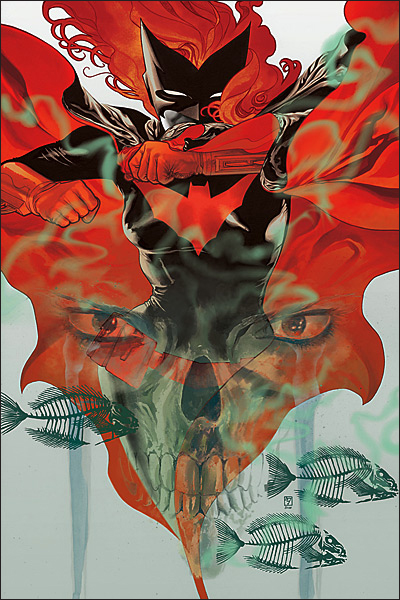
Or maybe not. After all, the art in Batwoman #1, by Williams and colourist Dave Stewart, is absolutely stunning, and the kind of comic where you can show one double-page spread to someone and sell them the comic right there. I know that because I did it! That’s how fantastic it is, and why I’m so glad the series has here.
The writing itself, by Williams and W. Haden Blackman, is worthy of similar praise. It’s different than Rucka‘s writing, but with the unity provided by the art, it all feels natural and fluid. With a single panel, the comic perfectly conveys the sadness and longing Kate has for her former girlfriend, Kate Montoya. It’s funny when Kate and Maggie Sawyer are flirting. Scary when the villain is present. This comic is an argument for why artists can be writers, too. This book flows beautifully, like a ghost through the cold night air.
But if the art and the writing can’t convince you, can’t adequately convey my love for this comic, I hope one thing can: how it make you feel. How did you feel when you first saw Batman? Scared? Inspired? In awe? That’s what Kate felt the first time she saw Batman, and it had a profound effect on her. Even more, when you see Batwoman for the first time in this comic, those are the feelings I got. She feels bigger than the page, bigger than a bit of paper and a couple of staples. She’s an idea, ripped from deep down inside us, the part that’s terrifying and wonderful. It made me pause in shock, and that’s a feeling I hope you’ll have, too. (J)
This is Comics! The Blog. We now commence our broadcast week.