
Hello comrades! I greet you from the bright orange heart of Soviet Alberta, where snow falls from the sky in May. It’s been a little weird here in my hometown, is what I’m saying. There have been some truly tremendous things that have happened to and around me in the past seven days, and my digressions about pop culture seem even more inconsequential than usual. As long as I’m enjoying myself, I suppose, that’s all that matters. What helped me enjoy myself this week? I’m glad I asked.
* * * * *
District X, or “NYPD Blue Skin and Glowing Eyes”
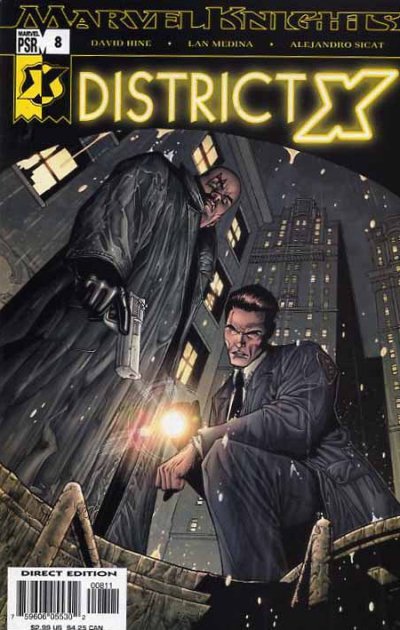
When Grant Morrison created the mutant ghetto known as District X in his run on New X-Men, part of what he was trying to do was to put a new twist on one of the most defining characteristics of the Marvel mutants — stand-ins for the disenfranchised. Practically since their inception, the mutant population of the Marvel Universe have been an allegory for many different repressed groups. The X-Men, despite their fantastic powers, have always been hounded for what makes them different. Even before I really read any X-Men comics, I knew it was a superhero book that touched on civil rights issues, however lightly. In his New X-Men run, Morrison shone the light on a kind of mutant that hadn’t really been seen in the X-books before — the lowly, downtrodden mutants; the ones without phenomenal powers but who were still marked as different; the ones who looked like monsters without actually having any real benefits. It’s one thing to use the handsome Angel or the beautiful Jean Grey as stand-ins for the downtrodden, but a teenage girl who has to shed her skin once a week or a grown man who hatches creatures from his body that reflect his emotional states? That’s a little bit more appropriate, though maybe less palatable for the stereotypical comic book reader.
In New X-Men, Morrison created a Manhattan neighborhood full of these kinds of mutants, an overcrowded neighborhood with high crime and low employment. The neighborhood was called (naturally) District X, and because Marvel was really high on having Grant Morrison redefine the X-Men, they eventually made a comic series of the same title that showed what life was like in that neighborhood. It’s a sentimental favourite of mine, because while it’s definitely not a great book by any standard, it’s definitely interesting. And sometimes “interesting” is more satisfying than “good.” I don’t know what it is about me that gets attracted to works with a gem of an idea that end up falling far short of their potential. But that’s District X to a T — a great concept that falters a little in the execution.
I have 12 of the series’ 14 issues, and in those dozen issues there are flashes of brilliance and terrible stumbles. The series focuses on Ismael Ortega, a human uniformed police officer working the mean streets of District X. The first issue is a cracker: Ortega is in the hospital visiting his former partner, an old-school head-cracker named Gus Kucharsky, who has been unconscious for a full day after being shot in the head while responding to a domestic disturbance call. Ortega walks an amnesic Kucharsky through the events leading up to the shooting, and in the process paints a very striking picture of life in this strange neighborhood. The issue introduces over a dozen characters including Ortega’s wife and two children, a number of locations that will be revisited during the series’ run, and firmly establishes the book as being a relatively straightforward police procedural, except with telepaths and mermaids. Writer David Hine crafts a terrific script for a story about cops doing a hard job in a tough neighborhood, and the fact that over half the cast are mutants is handled in such a way that the it all seems strangely normal.
By the end of the first issue, Ortega is told that Kucharsky is off the force and that Ortega will be acting as a special liaison to a federal investigator who’s been assigned to the area — Lucas Bishop, time-travelling X-Man from the future. It’s never really explained to the reader just how Bishop (who, since he is a black character in the early 21st century, has a shaved head and a goatee) came to be working for the FBI, but I honestly didn’t care. Bishop is the perfect X-Men character to add to the cast; he’s not big enough to draw attention to himself, he’s not small enough to make his presence inconsequential, and at least at this point in publishing history he’s disciplined and no-nonsense. When he shows up at the conclusion of issue one, the reader understands practically everything about the mission statement of the series, the neighborhood as it’s been established, and about Ortega as a new and layered character. It’s a tremendous set-up for what should have been, if not a best-selling series, at least a solid boutique book.
And then it immediately goes off the rails. Sure, the first storyline, Mr. M, is a story of mutant gang wars with mutant drugs and humans slumming in the mutant subculture, and it’s pretty great, but the writing is already on the wall, with penciler Lan Medina filling in for David Yardin twice in the first six issues before taking over as penciler in the second storyline. A fill-in on the third issue is not a vote of confidence.
The second storyline, Underworld, is pretty good, with a group of homeless mutants living in the tunnels under the city, but it buckles under the weight of a number of sub-plots, including one with Ortega’s jet-setting sister and her newest discovery, a mutant artist who paints the future. It’s as though Hine knew the axe was about to fall and tried to ratchet everything up a few notches and grab people’s attention, but he throws so many ideas out there that not all of them stick. He also leans quite heavily on the “mutants as a disadvantaged minority” allegory, grafting real life issues onto these characters in a way that sometimes feels disingenuous for what is, at its heart, a Marvel superhero book. I honestly appreciate everything that Hine tried to do with the book, but it was a case of too much too soon.
That doesn’t mean I don’t think people should read it, I absolutely do. Hine’s scripts still manage to feel honest and compelling even when they’re overwhelmed by too many ideas, and he’s a good storyteller who’s not afraid of letting his characters make mistakes or change or grow as the story progresses. The art is serviceable, but it’s Hine’s writing that really shines through here, and this is the book that made him a writer to watch in my eyes.
Whenever I recommend anyone read District X my pitch has has always been “it’s Law & Order in a mutant slum with Bishop instead of Jerry Orbach.” (Jerry Orbach is one of the greatest American actors of the 20th century, in my opinion, so that’s high praise.) I love it for what it tried to be more than what it actually is, even reading it 10 years on. At the very least it’s an interesting companion book to Morrison’s New X-Men, and the first storyline is actually a good little story in its own right.
* * * * *
This past week I also caught up with a couple of movie podcasts that had been recommended to me by two different friends. Here’s what I’ve been listening to.
Podcasts: You Must Remember This is a podcast created and hosted by journalist and author Karina Longworth, and is dedicated to exploring “the secret and/or forgotten histories of 20th-century Hollywood.” The first few episodes focus on such diverse subjects as the outer-space inspired recordings of Frank Sinatra, the life and times of B-movie maven Val Lewton, and the hard life of and ultimate demise of the amazing Judy Garland. (There’s a Bruce/Brandon Lee episode I’m looking forward to, as well as a long series about Hollywood stars during the Second World War.) Longworth puts together a meticulous show that is well-produced and well-researched, and even when I am familiar with the topics of the podcast I still find that they’re presented in an interesting way. As a podcaster, Longworth’s voice is smooth and yet her cadence can become halting at times, a combination that I find fascinating to listen to. It’s a podcast that I would recommend for people with an interest in American movies from any era.
Podcasts (Again): The other movie podcast I discovered this week is I Was There Too, hosted by comedian and podcaster Matt Gourley (Superego, The Andy Daly Podcast Pilot Project, James Bonding). The concept behind I Was There Too is an interesting one: finding people who were in small but important roles in famous movies and interviewing them about their experiences. What was filming The Untouchables like from the perspective of the woman pushing the baby carriage in the famous Union Station stairway scene? What did famous comedian Paul F. Tompkins think about filming a small dramatic role with Daniel Day-Lewis in There Will Be Blood? And just what does Greg Proops think about George Lucas’ directorial style during the shoot of Star Wars Episode I: The Phantom Menace? The answers to all these questions and dozens more can be found in these episodes. It’s clear that Gourley is a film nerd, and his excitement is palpable during the interview segments of the episodes, and threatens to take him off the rails during some of the other smaller segments (including “I Wasn’t There Too,” where Gourley talks about who was almost cast in these famous films). It’s both entertaining and enlightening, and with just over a dozen episodes published so far it’d be easy to catch up in no time.
* * * * *
That’s going to wrap it up for me this week. Until next time, I hope you can find time to dig deep beneath the surface of something you thought you already knew, and enjoy the discovery. I’ll see you in seven days.
