
This past weekend was full of comics reading, some good and some, well, let’s just be charitable and say not-so-good. I’ve picked two of the best to talk about this week; books that came out in the past five years or so, both well-loved and with very prestigious reputations.
* * * * *
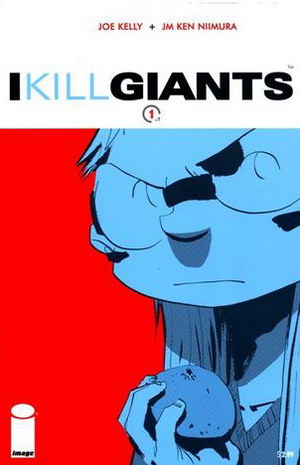 Comics: I Kill Giants is a critically acclaimed series that came out between 2008 and 2009 from writer Joe Kelly and artist J.M. Ken Niimura; I’ve had it on my bookshelf for a couple years now, and took some time this long weekend to finally check it out. It’s an all-ages book about Barbara Thorson, a socially marginal fifth-grader with struggles both in and out of school. Her home life is difficult and she has no friends, and appears to enjoy antagonizing the bullies and the teachers who make her life miserable. She also sees mythological creatures such as fairies and pixies, and carries around a tiny bag that contains a powerful mystic hammer that she uses, she says, to kill giants. The story is engaging and sweet, and even though I felt I knew where the book was going most of the time I still had one genuine moment of surprise. Niimura’s art is simultaneously sweeping and sketchy; his line can be scratchy and even feels incomplete at times, but he has a draftsman’s eye for remarkable page layouts. Furthermore, each of his characters has a simple but effective design with a variety of body shapes and sizes on display, which I found extremely refreshing. If I had read it in 2009 I might not have put it on my list of best comics for the year, but plenty of people did, so I feel like I need to give it another shot. Don’t get me wrong — I liked it, I just think there are so many people who absolutely adored it I feel I might have missed something on the first read.
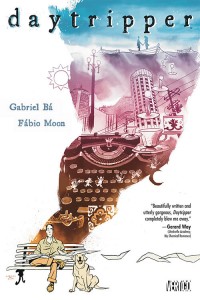 Comics: The first time I read Daytripper, the 2010 limited series from twins Fábio Moon and Gabriel Bá, I found it to be a transcendent experience. My re-read this weekend, nearly two years later, was not nearly as transcendent — it’s hard to have a work of art hit you with the same intensity the second time around — but I think I appreciated it more. Daytripper tells the story of Brás de Oliva Domingos, or rather, it tells his stories. It’s not spoiling much to say that practically every issue of Daytripper tells a story of Brás at different points in his life — the struggling 32-year-old writer of obituaries, the aimless 21-year-old traveller, the young 11-year-old boy who is struggling to find his own identity, and more. And each story ends with his death. Each issue builds on the others, in non-chronological order, to give the reader a full and complete picture of this character, and the first time I read it I was at first shocked and then transfixed. It was a way of telling a story I’d never encountered before, and it rocked me a little bit, trying to figure out how best to digest the story as a whole. The second time through, with the initial shock worn off, I was able to see what I think Moon and Bá were doing with the story. Each issue ends with the death of someone who, on the surface, appears to be the same man, and it’s as though his entire life could be summed up by the state of his life at that moment. But it’s all those moments that make him up, and it doesn’t matter at that precise moment if he literally died or simply if that version of himself died. No one knows the whole story until it’s over, and even then, the only person who really knows the story is the person living it. Daytripper is a beautiful, masterful book, a high watermark in comics storytelling and storytelling in general. It’s worth many, many reads, at different points in one’s life.
* * * * *
That’s about it for me this week; a bit of a short one but the quality of the books should make up for my brevity in writing about them. Until next time, read Daytripper and then read Daytripper again, because it’s really that good. I’ll see you in seven days.
