
Hello and happy Friday the 13th, Comics! the Blog readers! I hope you have fantastic plans for the Anna Howard Shaw Day weekend, but if you don’t, I might be able to point you in the direction of one or two pop culture nuggets to while away the hours.
* * * * *
The Vinyl Underground: Sexy Young People Solve Occult Crimes (Without a Stupid Dog In Tow)
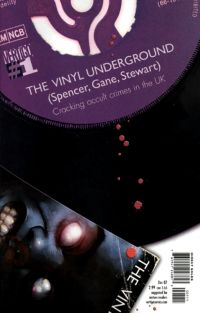
I have been a Vertigo Comics junkie from way back; some of my most formative experiences as a comics reader in my early 20s were books like Transmetropolitan, Preacher, Hellblazer, and yes, even Sandman (though to a far lesser extent). I would turn to Vertigo when I was looking for talented creators — sometimes under the radar and without much recognition — making interesting comics. For every smash hit like Fables there are three or four good but underrecognized titles like Unknown Soldier, The Exterminators, or American Century. There are also the Vertigo titles that never really grabbed me and/or were absolutely dreadful, whose names I will not mention to protect the good names of their creators. And then there are the titles that could have been something really special if given the time to play their stories out but instead were cancelled before they really got going, like the bizarrely beautiful and truncated The Vinyl Underground.
The Vinyl Underground came out from Vertigo in October 2007 and ran 12 issues before being unjustly cancelled. It’s a story of an eclectic team of young English people who have banded together to investigate various crimes on the streets of London. Writer Si Spencer (Judge Dredd, Books of Magick: Life During Wartime, the television show EastEnders) has created quite the foursome: Morrison Shepherd, ex-convict and tabloid celebrity DJ with an advanced criminology degree he earned while in prison; Leah King, forensic scientist and morgue assistant by day, camgirl by night; Perv, the autistic clairvoyant who doesn’t sleep; and Kim Abiola, Morrison’s ex-girlfriend, daughter of an African shaman and holder of a PhD in classical architecture. The Over the course of the 12 issues these four characters investigate a number of gruesome occult-related murders, bump up against London’s criminal underground, and uncover some of the dark secrets of Shepherd’s past. Every time they help out the police, they sign their work by leaving a seven-inch Otis Redding single behind. A bit precious, perhaps, but every crime fighting team has to have a gimmick of some kind.
It’s a book that starts out with a lot of potential and seems genuinely rushed towards the end. I am sure Spencer tried to wrap up all his story threads the minute he got word of the cancellation; the last two issues in particular feel rushed and quickly patched together. The first collection is a real treat, though, in large part due to the art team. Penciler Simon Gane (Northlanders; IDW’s Godzilla) has a knack for character design and panel composition; the way he uses a single page to introduce and explore a character through pictures, newspaper clippings, and other “found documents” is clever without being cute and gives just enough information without getting cluttered. He draws beautiful twentysomethings very well, whether they’re dancing at a club, arguing at a crime scene, or beating the living crap out of people. Cameron Stewart’s inks on the first six issues give the finished art a very clean and polished look; his soft and rounded inks really add a lot of depth and character to Gane’s straight lines and angular faces. Ryan Kelly’s inks on the last six issues don’t quite have the same visual punch but he definitely adds texture and depth to some truly gruesome and spooky scenes. Guy Major’s colours on all 12 issues are perfect whenever the scenes move from bright and modern to bloody and dark. The book looks really good, is what I’m saying, even when the story starts coming apart at the seams.
Ultimately I found The Vinyl Underground an exciting but flawed story, cut off at the knees before its time. Despite its flaws it’s well worth a read, especially for the spectacular art, and although the mysteries get solved a little too quickly, I’m glad to have it on my shelf.
* * * * *
Following the adventures of a quartet of sexy Londoners solving mysteries sounds like more than enough for one week, but a couple other things caught my interest too. Here’s what else I thought deserved a mention this week.
Movies: Until this week, my impressions of Mae West had been cobbled together through still photographs, a few short film clips, and imitations from various comedians. It wasn’t until this week that I saw an actual performance of hers, in 1933’s She Done Him Wrong, an adaptation of her stage play Diamond Lil. The film is only 66 minutes long but sometimes feels longer (the editing of the film destroys the pacing of some of the scenes), and I would have a hard time unequivocally recommending it to everybody. Still, it’s interesting to see exactly what the fuss was about Mae West, whose eyes are sometimes so hooded in her close-ups that she’s practically asleep; her entire performance is carefully constructed to establish her legend from the moment she appears onscreen. The film also features a very young Cary Grant, who isn’t given a lot to do but is still very nice to look at. As a movie fan I appreciated that She Done Him Wrong gave me the opportunity to finally get the Mae West experience, which is pretty spectacular. The rest of the movie is practically disposable, but whether or not one finds West’s power of personality compelling, it is certainly something worth seeing.
Books: Some We Love, Some We Hate, Some We Eat: Why It’s So Hard to Think Straight About Animals is a fascinating look at anthrozoology, the interactions between humans and other animals. Author Hal Herzog puts together a book that is well-researched without being dry and gives a cross-cultural examination of the bizarre and often contradictory way we humans view the animals that share our world. Whether it’s comparing cockfighting and poultry farming, looking at animal research, or what makes the same animals pests in one culture and pets in another, Herzog highlights just how difficult it can be to make practical and ethical decisions about animals. He also uses case studies and individual examples to highlight the points the research makes without using them as evidence in and of themselves, which I appreciated — plenty of non-fiction books seem to rest on how compelling individual stories are and ignore or contradict the evidence entirely. I found it a fascinating book that made me take a hard look at how I view non-human animals and kindled an internal debate I will be mulling over for many weeks to come.
* * * * *
That’s all for me this week, gentle readers. Until next time, hug a pet and listen to some Otis Redding. I’ll see you in seven days.
