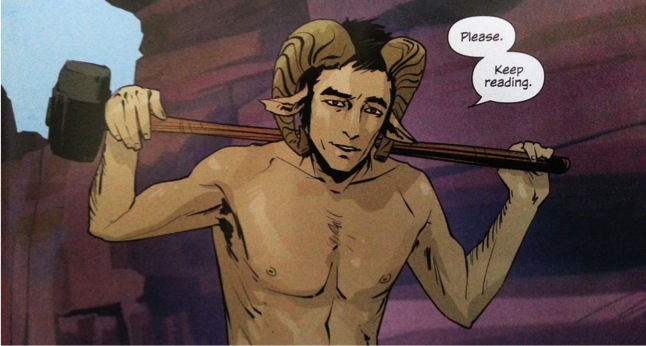

Hey you.
How’s it going? Maybe you’re new to this site. Maybe you’re here because you saw Brandon on the local news last Monday [Ed Note: and if not, catch it here!] and there was this giant, super sexy logo behind him. And realistically, you probably tried to google that name and discovered it’s the least SEO-friendly name in the world. I want you to remember that, because it’s going to come up a lot here.
Now, two things struck out to me in Brandon’s segment: first, the part where he talked about the Star Wars: The Force Awakens trailer as doing what it needed to do, i.e. get people excited about the franchise again, even though now they have to wait a year for the movie. Second, he recommended Saga, the Image comic from Brian K. Vaughan and Fiona Staples, for new readers. Then it struck me: these two are completely related, and could help solve a problem some people are having right now:
If you don’t want to wait for the next Star Wars movie, check out Saga. Why? I’m about to tell you.
First in the reasons why antsy Star Wars fans should look at Saga is because of the ways they’re similar, which starts right at the genre. No, not science fiction. There are a lot of different types of science fiction, and an interesting discussion I’ve occasionally stumble onto is the idea that whereas series like Star Trek are much more traditional science fiction stories, Star Wars is perhaps more accurately described as a Space Fantasy. And that definitely makes sense from a certain lens; the structure cribbed straight from Kurosawa, the mythic nature of it, the de-emphasis on explaining or investigating the advanced technology of the world, which is arguably deliberately undercut with the statement that it all happened “A long time ago”… I can see it. Plus, there’s that part where the focus of the entire series is on space wizards. Their training, their history, the spells they perform… for a lot of people, the science fiction is secondary to the literal magic of the world. That’s not an insult, either! It’s something that separates it from a lot of “hard” sci-fi, which I got thinking about because of a phrase Brandon used about Saga: he called it “soft science fiction.” That’s not only what makes it so accessible, but what makes it so similar to what things people like about Star Wars.
Like Star Wars, Saga is a series with a giant, mostly-left-to-the-imagination world, and the scope is familiar, right down to the way the lead characters are introduced: as small cogs in a giant, uncaring world and a conflict they’ve somehow found themselves a part of. There is advanced technology befitting a world where two races are at war across the galaxy. There are robot aliens with TVs for heads. There is a spaceship made out of a tree! Weird holo-soap operas, too! These are all very cool things, and they serve to give the impression that the world of Saga is big and weird and different from what we know. It’s a world where things operate differently, for sure. But interestingly, the technology is rarely given the actual emphasis in the book. Instead, like in Star Wars, it’s more atmospheric. It gives the impression of wonder and scope, but it leaves the adventure and the heroes’ journey as the point. Heck, a character has a glowing, powerful sword, which is almost as close as you can get to Star Wars without a cease and desist. But unlike Star Wars - and definitely unlike a lot of sci-fi - it’s not a piece of technology.
It’s magic.
Not metaphorical magic (though there is that, too), but legitimate magic. Marko, a main character, performs spells, and so does a family member. A main character is a ghost. Like Brandon said on the news, this is soft sci-fi. It breaks up the idea of a hard, technically-minded science fiction when you have a bisected teenage ghost teen who babysits a space baby after being bonded to her with a spell in the same way that having the focus of Star Wars be space wizards does. And if the idea of space wizards getting caught up in a war across the galaxy as they try to take care of their friends & family doesn’t remind you of Star Wars, then you must have missed all the space ghosts and spells when you were busy complaining about The Phantom Menace.
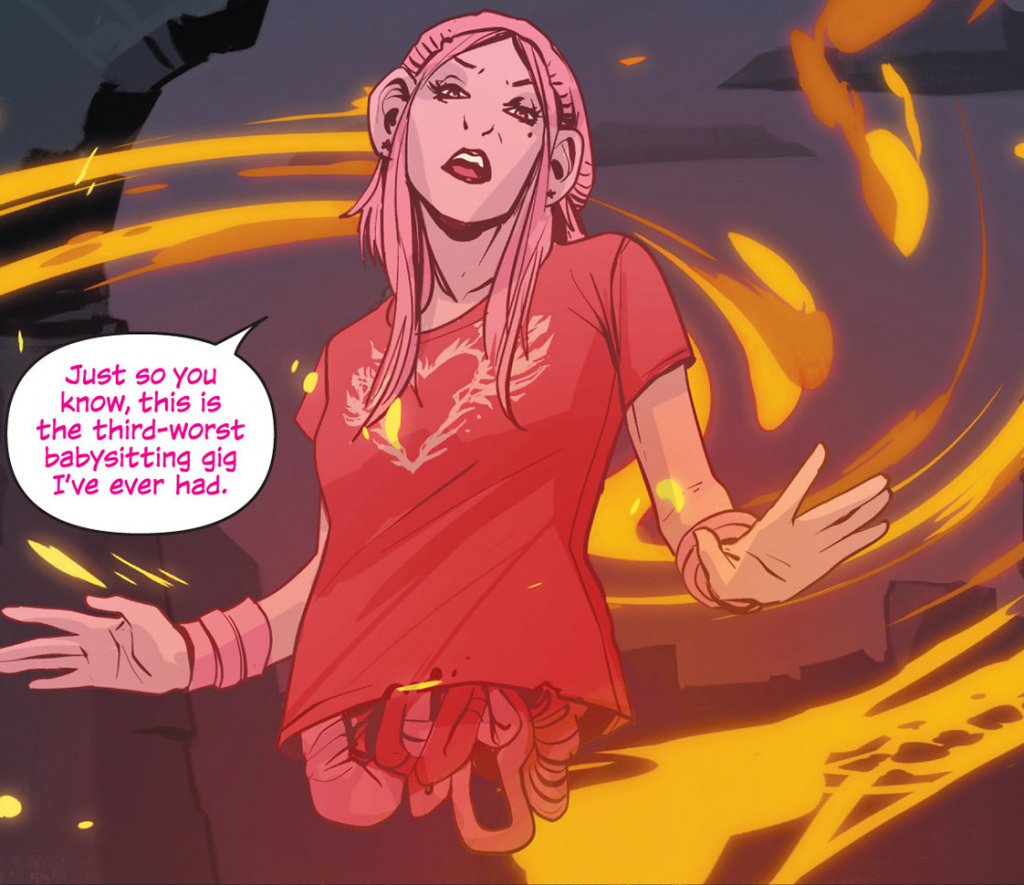
The second reason why you might want to check out Saga if you’re excited about The Force Awakens is something that people have been hoping for in the new movie but that’s notably missing from the original trilogy: diversity. To a lot of people, as much as they love the original Star Wars movies, there seem to be a lot of white dudes and not a lot of women of people of colour, so the news about the casting of Lupita Nyong’o, Gwendoline Christie and John Boyega got people excited. Similarly, a lot of excitement about the Force Awakens‘ trailer is on how it places a black man and a woman prominently as the first people you see. And that is definitely cool, but if you’re jazzed about that, are down with space magic and want to occupy yourself in the meantime, then I’d be remiss in not mentioning that Saga is one of the most casually diverse comics out there. In fact, white dudes are a minority in the book; Marko, the father in the book’s core cast, is light-skinned, but he’s hardly the Slavic ideal of superhero comics. More importantly, however, are the women that surround him, like his black wife Alana, his mixed-race (and species) daughter Hazel, her babysitter Izabel, his mother, his ex-fiancee, and so on. The book is full of so many women of so many different shapes, races and species, so beautifully realized by artist Fiona Staples, that Saga reads as a celebration of all of society, and not just the small subset of straight white dudes that superhero comics and, to a large extent, Star Wars, have often represented as being the norm. Saga, despite being a comic book about star-crossed lovers of different species traveling across a wild and weird galaxy in a spaceship tree and meeting non-humanoid members of other species, reads more like real life than most comics, and it embodies the things that people are hoping The Force Awakens will be. So why wait a year? You can get that beautiful testament to imagination and art right now.
Buy Saga online at ComiXology, in printed collections at Amazon, or head on down to your local comic book shop to pick up collections or single issues.