

It is two weeks until summer vacation, folks, and my current workload is overwhelming my tiny little mind and threatens to drive me mad. Luckily, when all around me seems dark and I am alone in my apartment, I have shelves full of things that can distract and soothe me.
Human Target: Strike Zones
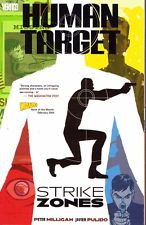
The 2003 Vertigo series Human Target is a study of identity and duality. This version of Christopher Chance is an adaptation of an old DC property, who is himself an adaptation of an even older DC property. I don’t know how well the Human Target concept worked in the 1970s, but this 21st-century “Mature Readers” version is slick and vicious and thought-provoking.
To bring everyone up to speed, Christopher Chance, the Human Target, is a bodyguard who specializes in assuming the identity of the person he’s been hired to protect. At the beginning of the first collection, Strike Zones, he has suffered some severe physical and psychological trauma, as not only does he alter his appearance to look like his clients, but he also learns everything about them and psychologically becomes the clients as well. Sometimes this works a little too well, and Chance becomes caught up in the illusion.
That’s the case in the first story of this collection; a first issue that closes out the story started in Human Target: Final Cut (an original graphic novel that is not in this collection). I found it a little bit confusing without that first story, but the comic is so well made it hardly matters. The real meat of the collection comes in the volume’s two other stories.
First of all, the art in this collection is by Javier Pulido, who has been been getting rave reviews for his recent She-Hulk work. I can can absolutely see the roots of that beautiful art here. He is versatile in so many ways: how he frames his characters in the panels, the pitch-perfect facial expressions, the use of light and shadow for dramatic effect. He even varies his line work to change the impact of the narrative. In one story he limits himself to what looks like a single pen line, while in another he uses a brush to vary the thickness. Pulido takes a simplistic style and does so much with it; only after I re-read some pages did I realize how much skill he put into making them seem simple and effortless. This collection also highlights his uncanny ability to lay out a page: his action scenes are kinetic and quickly paced, while others that focus on dialogue and character take the time to breathe. There’s one page in particular, where Chance is talking with another character and learning how to play baseball, that knocked me for a loop. The page uses a simplistic panel layout and the dialogue balloons dance around them, with one panel being used to reference more than one line of dialogue. That’s a page made by someone with a firm grasp on how to tell a comics story.
(I don’t know much about art, but I liked Pulido’s work on this title so much I figured the least I could do was to talk about it first.)
Aside from the art, my favourite thing about this volume of Human Target is the way it explores the nature of identity and who a person really is inside. Peter Milligan’s Christopher Chance is the epitome of a character struggling with his identity, but he’s not the only one who appears in these stories, nor is he the most interesting one. In Milligan’s Human Target, Chance is a cipher; the other characters are what really matters. Whether it’s a man who faked his death after the World Trade Center attacks or a baseball player whose glory days are behind him, they aren’t who they believe they are inside, either. So when Chance takes over their lives, those characters are confronted by things they normally keep locked down or have denied so often they have completely forgotten about.
I particularly loved how the story “The Unshredded Man” turned out. I initially felt sorry for the main character — a man who was forced to do shady business deals by his bosses and uses the 9/11 attacks as a way to escape from prosecution — but only after Chance becomes him did I realize that “lost man” identity was just a façade he puts on to be able to look at himself in the mirror. As the story goes on, that façade keeps cracking and falling off. That great, slow unraveling of a character, being confronted with the fact that the identity he had created for himself was a lie, was the most satisfying part of this story.
The other story in the collection, “Take Me Out To The Ball Game,” is engaging and exciting in a very different way. To investigate the suicide of a professional baseball team’s star player, Chance takes the identity of a washed-up player and discovers something ugly under the All-American surface. I hate baseball as a sport, but who can’t identify with a character who feels like their best days are behind them and would do anything to get them back? That character’s journey is touching and real — things don’t wrap themselves up nicely, but the character makes an important decision, and you realize that decision is what the whole story has been leading up to. It’s not justice for a man who committed suicide; it’s a step forward for a man who’s been in neutral for the past few years.
Milligan and Pulido’s run on Human Target is so good, it’s a shame that DC hasn’t collected this run in its entirety, or released the entire series digitally (Comixology only has the first six issues). If the rest of the stories are as good as these first few, I will have to try to find the back issues at the next convention I attend.
* * * * *
Although character studies disguised as espionage thrillers may have been the highlight of my week, there are still a few other things that I enjoyed and want to share with you. Here’s what else made the past seven days more bearable.
Television: I have been re-watching a lot of 30 Rock the past couple of weeks. I wanted to write about it here because I love it so, but what more can I say about 30 Rock that hasn’t already been said? I think it’s probably the best network television comedy of the past 10 years (sorry Parks and Rec and Community, I love you both but 30 Rock is the most consistently funny and well-crafted over the full run of the series) and it is amazing that a series that was criminally under-watched made it for 138 episodes. I know that there are people out there who don’t like Tracy Morgan, and I was one of them — until I saw 30 Rock. Now I laugh at even the thought of lines like “Grizz was in the Navy” or “Stop eating people’s old French fries, pigeon. Have some self respect! Don’t you know you can fly?” or “I once saw a baby give another baby a tattoo! They were very drunk!”
Anyhow. I still love 30 Rock. Let’s move on.
Television: If you haven’t been watching Cosmos: A Spacetime Odyssey then you are missing some of the most fascinating and riveting viewing I have been fortunate to have had this year. Forget that it’s a call for activism and science education for the masses, something that has me jumping up and down for joy. Forget that the computer-generated imagery is the best I’ve ever seen on television. Forget that the host is the irascible and charismatic Neil deGrasse Tyson, whose bedroom eyes are divine according to Brandon and James. What impresses me the most is the way the creators craft the story of every episode. The writing staff of Cosmos tie historical anecdotes together with current scientific breakthroughs, with thematic resonance that I find absolutely breathtaking. Cosmos also did something very surprising: it made me optimistic for the future. Not my future, or the future of humanity, but the future of the planet. That is something special. The last episode has already aired but the DVD/Blu-Ray sets became available this week. I urge you to get a copy and settle in and watch it with someone you care about. If it’s the kind of show that can plant the seed of hope in my dry and dusty soul, imagine what it could do for someone who’s still young and idealistic.
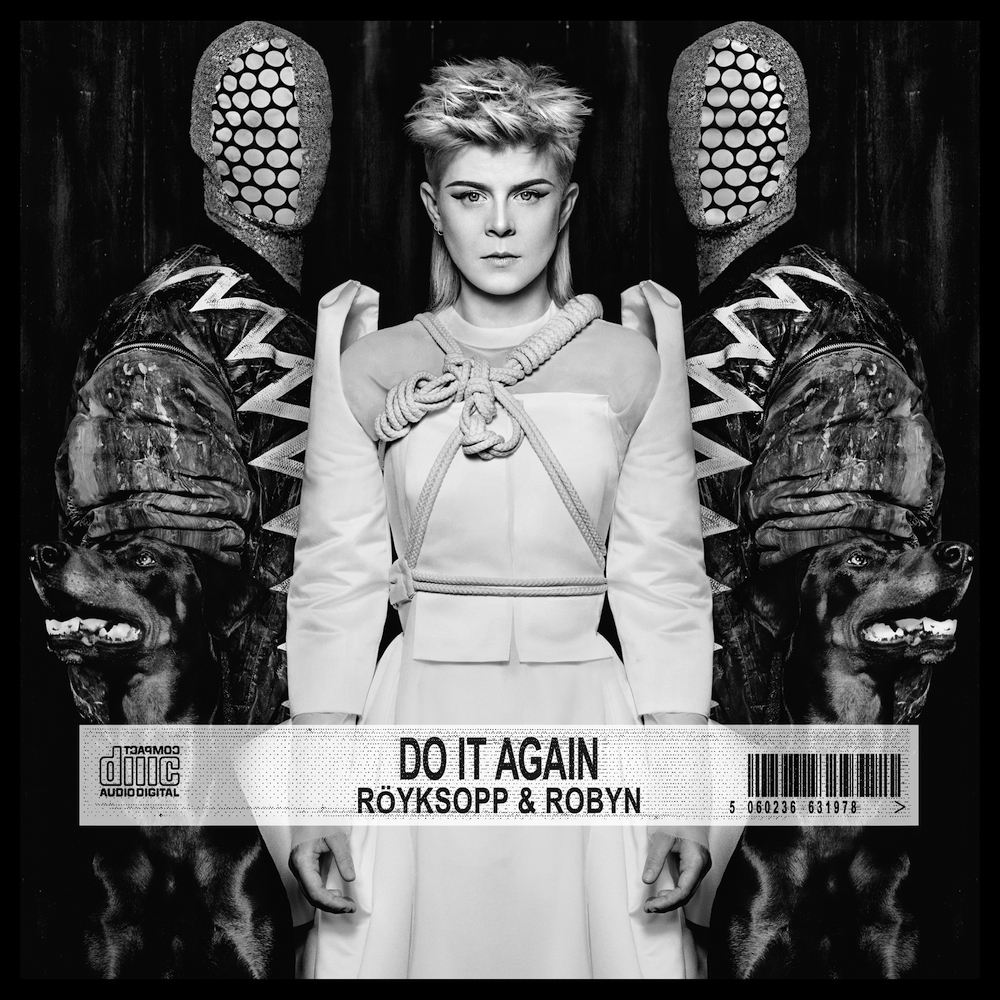 Music: Did you like the soundtrack for Drive but thought it would be better if it included a bouncing club track and also more lyrics about robosexing? Well, I didn’t know that I wanted that, but after listening to Röyksopp & Robyn’s collaborative EP Do It Again, I never don’t want it. It’s five tracks and 35 minutes, and if you don’t like creepy pop-electronica you might want to steer clear, but this album is exactly what I needed at this point of the year. It’s beautifully and interestingly flawed. For example, 75 per cent of the opening track “Monument” is dark and pop-y and groovy. It would be the best song on the track, if only there weren’t two saxophone solos. “Sayit” is the aforementioned robosexing track and it is tongue-in-cheek greatness, thematically echoing Robyn’s “Robotboy” and “Fembot” with a great driving beat. “Do It Again” is the most Robyn-like song; it’s lyrically simple and a fun dance track in praise of hedonism until it turns on its heel in the last bit, which gives the upbeat lightness of the first half a cutting edge. And to round it out, “Inside the Idle Hour Club” is a long and mellow album ender, the finish to a crazy late night out. (Not that I’ve had any recent experience with that, but it’s like I remember it being when I was young.)
* * * * *
And that will definitely do it for me this week — I have a show on Saturday that is stressing me out and I need to curl up in my security blanket and watch more Tina Fey. Until next week, check out those issues of Human Target online if you can, and then surround yourself in something that soothes you, whether that be an electronic opus or the wonders of science. I’ll see you in seven days.
