

The past seven days have felt like they’ve sped by in an absolute blur. That might be because I spent a lot of time watching True Detective, and as you know if you’ve watched that show, time is a flat circle, which means that I have already written this column, and am destined to write it again. So what will I have had been writing about this week? Let’s begin to have already find out!
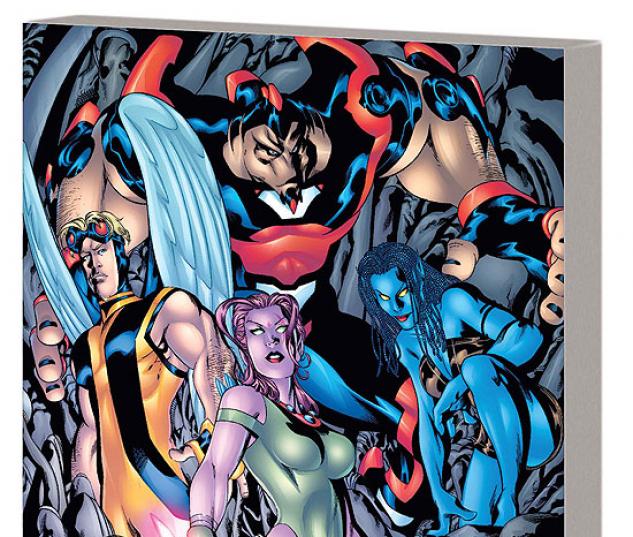
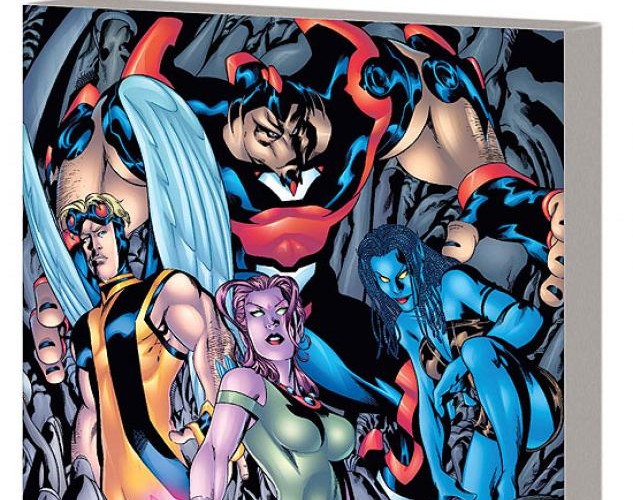
Exiles Ultimate Collection: Volume One
Writing about Batman & Robin last week made me think about Judd Winick and his unfortunate reputation as a poor writer of superheroes. The vast majority of everything I’ve ever read about the man on the Internet is disparaging of his work on Batman in particular, and that seems to extend to “Winick can’t write superheroes.” Which is absolutely untrue, because his work on Exiles is great.
If you haven’t read Exiles before, let me give you the elevator pitch: it’s Marvel’s What If…? plus Quantum Leap filtered through the X-Men characters.
Okay, a longer explanation may be necessary. In the first issue of Exiles, six superheroes from different Marvel realities are plucked out of time and gathered together by someone called the Timebroker. He tells them that they have been gathered together because their realities (and countless other Marvel realities) are broken, and they have to fix them. If any one of them fails or dies on their missions, they get sent back to their broken realities, where they may have become orphans, imprisoned under a dystopian government or perhaps they never would have existed.
And the Timebroker makes it very clear that (despite his name) what the Exiles are doing is not time travel, it’s dimension-hopping. On the face of it this can seem like splitting hairs but it’s actually quite clever. If the team can’t be sent backwards and forwards in time, the writer has a defense against readers who might say, “Why don’t you just send the team back before the Skrulls took over the Earth and prevent it from happening in the first place?” Because it’s not time travel. It’s a different dimension. You do the best with the situation you have, Exiles, and the decisions you’re forced to make become that much more immediate. Do you kill a child to save a future? Do you save a villain to prevent a bigger villain from taking his place? If you’re the Exiles, you do it or you risk your own annihilation.
As a storytelling concept, Exiles is a gold mine. It allows a clever creative team a near-infinite canvas to imagine and re-imagine a familiar fictional universe. It’s a What If…? pitch that mutated into something even more fantastic. You can put new spins on old characters, turning heroes into villains and vice versa. You can change one event or aspect of a familiar storyline and explode it, creating worlds where Sentinels eventually wipe out or imprison all superhuman life, or where Wolverine never left Canada and becomes field commander of Alpha Flight, or where The Lizard infects dozens of people and a new species grows to take over the entire East Coast of the United States. These ideas and more are explored in Winick and company’s run on Exiles, and in the first Ultimate Collection, it never got old to me.
If Exiles was just a bunch of displaced X-Men exploring alternate dimensions, though, I wouldn’t like it as much as I do. In between all the universe-in-peril stories, there are great character moments, something that Winick is very, very good at. When I first read these comics, none of the main characters were familiar to me, either because I hadn’t read any of the books that they had previously appeared in (in the case of Blink, Morph and Mimic) or because they were original characters (in the case of Nocturne). But over the course of the first 19 issues, Winick gives each character at least one great moment. Whether it’s two people falling in love amidst all the chaos, or losing one’s faith or having your darkest secret used against you, you start seeing each of the Exiles as a fully realized character. Which makes it even harder when one of them leaves the team under awful circumstances.
The two pencilers for these issues complement each other well, without being copies of each other. Mike McKone has a line that flows and Jim Calafiore’s is more angular, but both make for great superhero action as well as human moments with humour, drama and sadness. Out of the two, Calafiore is my favourite — this was the first time I’d seen his work, and going back to it after seeing it on Secret Six (another favourite underrated series of mine) makes for interesting comparison. Issue 11, “Play Date,” is probably my favourite issue of the entire run, and he and inker Eric J. Cannon handle every panel with skill and finesse, whether it’s an excuse to draw superheroine cheesecake, Morph’s shape-shifting caricatures or quieter character moments. I probably re-read that issue four or five times this go-round, and enjoyed it every time.
Exiles is a little dated in terms of the costumes, pop culture references and some turns of phrase, which makes sense for a book that was trying to be very current almost 15 years ago. But the stories are great.
* * * * *
Dimension-hopping mutants aren’t the only thing that have occupied my time this week, however. There have been a few other things of note that I’ve enjoyed.
Television - You may have deciphered this from my incomprehensible intro, but I finished True Detective, folks. Without spoiling anything: it is not perfect, but it is an incredibly good example of both visual and sequential storytelling. You know a TV show is good when you start thinking absolutely ridiculous things about how it’s going to play out, and you’re allowed the luxury of that thought process because of how compelling the characters and the story are. The story seeds that were sprinkled through the season absolutely earned the story’s ultimate payoff, and whether you think it’s going to be supernatural or rooted firmly in reality I think you will ultimately be very satisfied. And the climax was thrilling. My blood ran alternatingly cold and hot, and yes, I jumped in my seat at a couple of points. And the denouement was a nice capper to the story as well — things don’t get neatly wrapped up but there is a sense of closure for the story and for the characters. If you’re remotely into crime fiction or weird fiction, you have to watch it. You HAVE to.
Comics - Scarlet Spider continues to be good with Volume 2: Lone Star, though I feel Chris Yost is leaning a little hard on Kaine’s “Why am I getting involved with this?” anti-superhero tendency. I still like the take on a villainous character’s journey of redemption, and Khoi Pham’s and Tom Palmer’s work on “The Second Master” is definitely a change from Ryan Stegman but still very enjoyable and action-packed. The events in “In The Midst of Wolves” open up the story possibilities, too, and give a pretty good cliffhanger for the next volume to pick up on. Some of the characters seem like they will end up going away forever when this series is over, but being important in the grand scheme of continuity doesn’t make something good. I am pleasantly surprised at what I thought would be a completely skippable Spider-series.
Television - If you had asked me last year what my go-to TV drama would be this season, Arrow would not have been my first answer. Or even my fourth. But dang it, the show has taken the goodwill it had at the end of the first season and rolled it into a really compelling super-soap with fun action sequences and a story that gets crazier with every episode. “Suicide Squad” was a bit of a breather, taking the viewers out of the Team Arrow vs. Slade storyline for a moment. Instead, “Suicide Squad” put most of its focus on Diggle — a character that I feel has been unfairly sidelined in recent episodes — joining sides with the Arrow-verse’s version of the Squad. I was looking forward to it because I love John Ostrander’s original Suicide Squad run, and this episode did a pretty good job of reinventing the concept for the show’s continuity. However, it also really underlined my problem with young, hot, and skinny Amanda Waller. With all the steps that comics have taken in recent years to increase diversity, young, hot, and skinny Waller is a decrease in diversity. It’s at least palatable in the Arrow universe because literally everyone in Arrow is a younger, hotter version of the characters I remember from the comics. What little I read of her in the new DC continuity takes the things that made post-Crisis Waller interesting (a family, years of experience, a no-nonsense attitude and thick skin that she developed because of her appearance) and tosses them out for youth and sex appeal. I’m not against youth and sex appeal, mind you, or else I probably wouldn’t be watching Arrow. Maybe I just miss the old Waller. All this grumbling will probably get me to pull out more of my Suicide Squad issues to read for next week, though, so that’s something.
* * * * *
And that’s it for this week, folks. Until next time, pick a neglected old favourite book or comic off your shelf and give it some love, and watch True Detective already. I’ll catch you in seven days.
